C# Namespaces: Organizing Code and Avoiding Conflicts
Learn how C# namespaces organize types, resolve naming conflicts, and affect code structure. Practical examples and common pitfalls included.
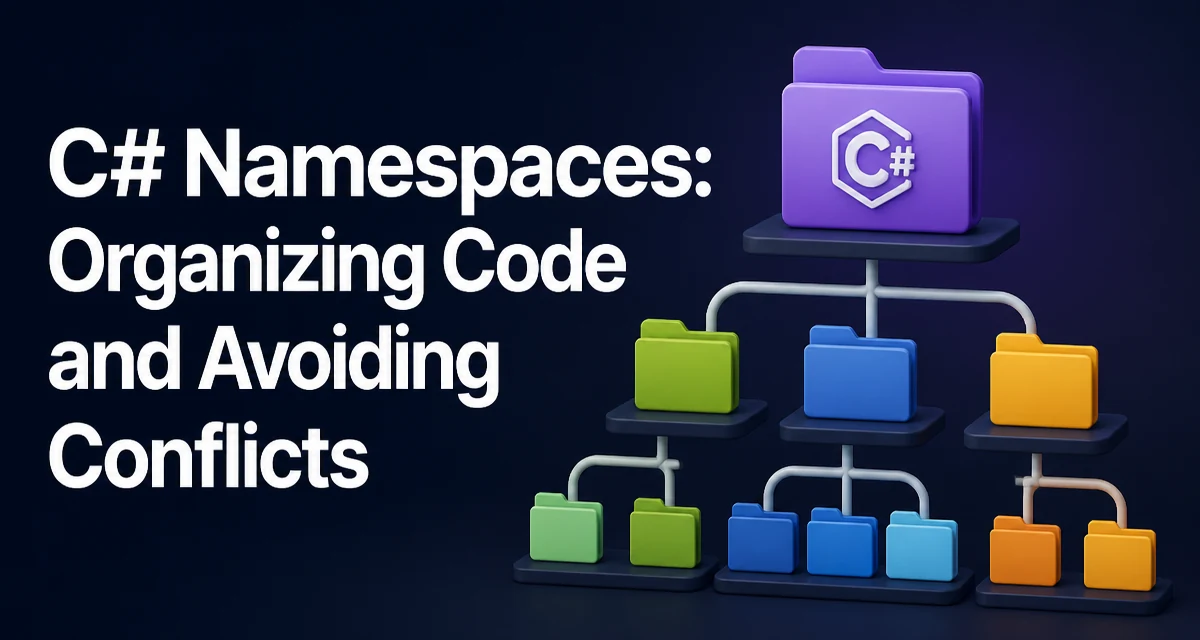
In C#, a namespace is a logical container that groups related types such as classes, structs, interfaces, and enums. Its main purpose is to organize code and prevent naming collisions across a codebase. The examples below show the core syntax and behavior, including how the compiler resolves type names and how namespace choices affect maintainability.
The Role of Namespaces in C#
Namespaces serve two distinct but related functions. First, they group semantically related types, making it easier for developers to locate and understand the public API of a library. For example, all collection types in the .NET base class library live under System.Collections, while file I/O types are under System.IO. This grouping is purely logical; it does not dictate where the types are physically stored or which assembly they belong to.
Second, namespaces prevent name conflicts. Two different libraries can both define a class named Configuration, and as long as they are in different namespaces, they can coexist in the same project. When you reference both types in a source file, you must disambiguate them either by using a fully qualified name or by importing one namespace with a using directive and aliasing the other.
A namespace is not a runtime concept. The Common Language Runtime (CLR) does not execute namespaces; it only sees fully qualified type names. The compiler translates a namespace declaration into part of the type's metadata name. This means namespaces have zero runtime overhead and do not affect performance, memory usage, or type loading behavior. Their impact is entirely at compile time and during code maintenance.
Declaring and Using Namespaces
You declare a namespace with the namespace keyword followed by a dotted name. The declaration can contain any number of types, and you can also nest namespaces inside each other.
namespace MyCompany.Project.Data
{
    public class Customer
    {
        public string Name { get; set; }
    }
}
The dotted name MyCompany.Project.Data is equivalent to declaring three nested namespaces: MyCompany contains Project, which contains Data. You can also write nested blocks explicitly, but the dotted form is more concise and is the convention used in most codebases.
To use a type from another namespace, you have two options. You can reference it by its fully qualified name, which includes the entire namespace chain:
public class Order
{
    public MyCompany.Project.Data.Customer Customer { get; set; }
}
Or you can import the namespace with a using directive at the top of the file:
using MyCompany.Project.Data;

public class Order
{
    public Customer Customer { get; set; }
}
The using directive does not include types from nested namespaces. If you need a type from MyCompany.Project.Data.Models, you must import that namespace separately. This is a common source of confusion for developers new to C#.
You can also create an alias for a namespace or a specific type to resolve ambiguity or shorten long names:
using CustomerData = MyCompany.Project.Data.Customer;

public class Order
{
    public CustomerData Customer { get; set; }
}
Aliases are particularly useful when two imported namespaces contain types with the same name. Without an alias, the compiler will report a conflict and force you to use fully qualified names for at least one of the types.
How the Compiler Resolves Types
When the C# compiler encounters a type name, it first checks the current namespace and its parent namespaces. If the type is not found there, it considers namespaces imported with using directives. If exactly one match is found, that type is used. If multiple imported namespaces define the same type name, the compiler reports an ambiguous reference unless one of the types is in the current namespace, in which case the current namespace takes precedence.
Consider this example:
namespace App
{
    using System;
    using System.IO;

    class Program
    {
        static void Main()
        {
            var info = new FileInfo("test.txt");
        }
    }
}
If System.IO.FileInfo is the only FileInfo type visible, the code compiles. If you also import another namespace that defines a FileInfo class, you get an ambiguous reference. The compiler does not merge types; it requires you to disambiguate. This behavior is deterministic, but it can surprise developers when a newly added using directive breaks previously working code.
Another important rule is that a using directive inside a namespace block only applies to that namespace, not to the entire file. This is different from a top-level using directive, which applies to the whole file. Placing using directives inside a namespace is a common practice to keep the scope narrow, but it can lead to subtle resolution differences if you move code between files.
Organizing Code with Namespaces
There is no enforced relationship between a namespace and the physical folder structure of a project. You can put a class in any file and give it any namespace. However, the .NET community has adopted a convention that matches the namespace to the folder path. For example, a class in Models/Customer.cs is usually declared in the MyApp.Models namespace. This convention makes navigation predictable, especially in large solutions.
When you create a new project in Visual Studio or the .NET CLI, the default namespace is often derived from the project name. For a project named MyApp, the root namespace becomes MyApp. As you add folders, the namespace typically extends accordingly, though you can override this behavior in the project file or by manually editing the namespace declaration.
The choice of namespace names affects how easily other developers can understand your code. A good namespace hierarchy follows the dependency direction of the code. Types that are used together should be in the same namespace or in closely related namespaces. Avoid creating a single namespace that contains unrelated types, as this defeats the organizational purpose.
A common pattern is to use the company name as the first segment, followed by the product or project name, and then the functional area. For example, Contoso.Reporting.Core and Contoso.Reporting.Data. This pattern scales well across multiple teams and shared libraries.
Common Namespace Pitfalls
One of the most frequent mistakes is placing a using directive inside a namespace block and expecting it to affect the entire file. The directive only applies to the enclosing namespace. If you have multiple namespace blocks in one file, each block needs its own using directives. This is rarely a problem in practice because most C# files contain a single namespace, but it becomes relevant when you use file-scoped namespaces.
File-scoped namespaces, introduced in C# 10, allow you to write namespace MyApp; at the top of the file without braces. All types in the file belong to that namespace. This syntax is more concise, but it changes how using directives are scoped. There is no namespace block to contain them, so a using directive can be placed before or after the namespace declaration, as long as it appears before the first type declaration; in practice, keep the placement consistent. Mixing file-scoped and block-scoped namespaces in the same project is allowed but can confuse developers who expect consistent behavior.
Another pitfall is relying on the global namespace. Types declared without a namespace are placed in the global namespace, which is always accessible. This is acceptable for small scripts, but in a larger project it leads to naming collisions and makes it harder to control visibility. Even if you never reference the type from another assembly, a global type can conflict with a type imported from a library.
Naming conflicts can also arise when you import two namespaces that contain types with the same name. The compiler does not pick one arbitrarily; it reports an error. The fix is to use a fully qualified name or an alias. A common mistake is to try to resolve the conflict by removing one using directive, which may break other types that depend on that namespace. Aliases are the safer approach because they keep the import for the rest of the code.
Namespaces and Maintainability
Namespaces have a direct impact on long-term maintainability because they define the public contract of your code. Changing a namespace is a breaking change for consumers. If you rename a namespace in a library, any code that references types in that namespace must be updated, and binary compatibility is lost. The .NET runtime treats the fully qualified type name as part of the type identity, so moving a type to a different namespace creates a new type from the runtime's perspective.
To avoid breaking changes, think carefully about namespace names before publishing a library. Once a namespace is public, it is difficult to rename without a major version bump. If you need to reorganize types, plan the migration as a separate compatibility effort; a compatibility layer usually adds complexity and is rarely worth the effort.
Within a single application, you have more freedom to refactor namespaces because you control all the callers. However, even in a monolithic solution, frequent namespace changes make code reviews noisy and can hide meaningful changes in the diff. It is better to establish a namespace structure early and adjust it only when the architecture genuinely changes.
Another maintainability concern is namespace pollution. When you add many types to a single namespace, the list of available types becomes large, and the chance of name collisions increases. This also makes it harder for developers to discover the right type. Splitting a large namespace into smaller, focused ones improves readability but requires more using directives. The tradeoff is usually worth it for namespaces that contain more than a few dozen types.
Namespaces vs. Assemblies
A namespace is a logical grouping, while an assembly is the physical unit of deployment. One assembly can contain many namespaces, and one namespace can be spread across multiple assemblies. For example, the System namespace is defined across several assemblies in the .NET runtime. This distinction is crucial for understanding how dependencies work. When you reference an assembly, all of its public types become available to your project, but you still need either a using directive or a fully qualified type name to refer to them.
Choosing the right assembly boundaries is a separate decision from namespace design. Two types in the same namespace might be in different assemblies, which means they can have different versioning and deployment schedules. This is common in large frameworks where the core types are in one assembly and optional extensions are in another. Namespace design should not be driven by assembly boundaries, but you should be aware that moving a type between assemblies is a binary breaking change even if the namespace remains the same.
When you create a new project, the default namespace is derived from the project name, but you can change it. If you plan to share types across assemblies, choose a namespace that reflects the logical domain rather than the project name. For instance, a project named Contoso.DataLayer might use the namespace Contoso.Data to avoid coupling the logical name to the physical project structure.
A practical approach is to define the namespace hierarchy first, then map each namespace to an assembly based on deployment needs. If all types in a namespace are always deployed together, they can live in the same assembly. If some types are optional or have different update cycles, split them across assemblies while keeping the same namespace. This gives you flexibility without changing the logical organization.
Namespace and Compile-Time Resolution Cost
While namespaces have no runtime cost, they do affect compilation time. The compiler must resolve type names during compilation, and a large number of using directives can slow down the resolution process, especially in projects with many files. This is rarely a bottleneck in practice, but it becomes noticeable in very large solutions with thousands of files. The compiler caches resolution results, so the impact is minimal after the first build.
More significant is the effect on IntelliSense and code analysis tools. A file with many using directives imports a large surface area, which can make the editor slower and increase the chance of showing misleading suggestions. Keeping using directives minimal and scoped to the actual types used improves editor responsiveness and reduces noise. Modern IDEs provide features to remove unused usings, which is a good habit to apply regularly.
There is also a subtle interaction with source generators and analyzers. Some source generators rely on namespace names to generate code. If you rename a namespace, the generated code may break. Always run a full build after changing namespaces to catch such issues.
Designing a Namespace Hierarchy
A well-designed namespace hierarchy follows the principle of least surprise. Start with a stable root, such as your company or product name. Under that, add layers that represent major functional areas. Avoid deep nesting beyond three or four levels, as it makes fully qualified names long and using directives verbose. If you find yourself writing namespaces like Contoso.Reporting.Data.Providers.SQL, consider whether the intermediate levels add value.
One common pattern is to separate the public API from internal implementation. For example, Contoso.Reporting contains the public types, while Contoso.Reporting.Internals holds types that are not meant for external consumption. This is a convention, not a language feature; the compiler does not enforce it. If you need true enforcement, use the internal access modifier instead of relying on namespace naming.
When you add a new feature, extend the namespace tree in a way that mirrors the existing structure. If you have a Models namespace for data objects, do not put a new data object in the root namespace just because it is small. Consistency matters more than convenience. A developer who knows where to find a type in one part of the codebase should be able to predict where a similar type lives in another part.
Finally, remember that namespaces are a form of documentation. The name itself should convey the purpose of the contained types. A namespace named Utils or Helpers is a warning sign that the code inside is probably a grab bag of unrelated functionality. If you cannot describe the common purpose of the types in a namespace in one sentence, consider splitting it.