Go Error Handling: errors.Is, errors.As, Sentinel Errors, and Custom Types
errors.Is and errors.As explained through the wrapping that makes them necessary: %w chains, multiple wrapped errors, custom Is methods, and the pointer rules that make As panic.
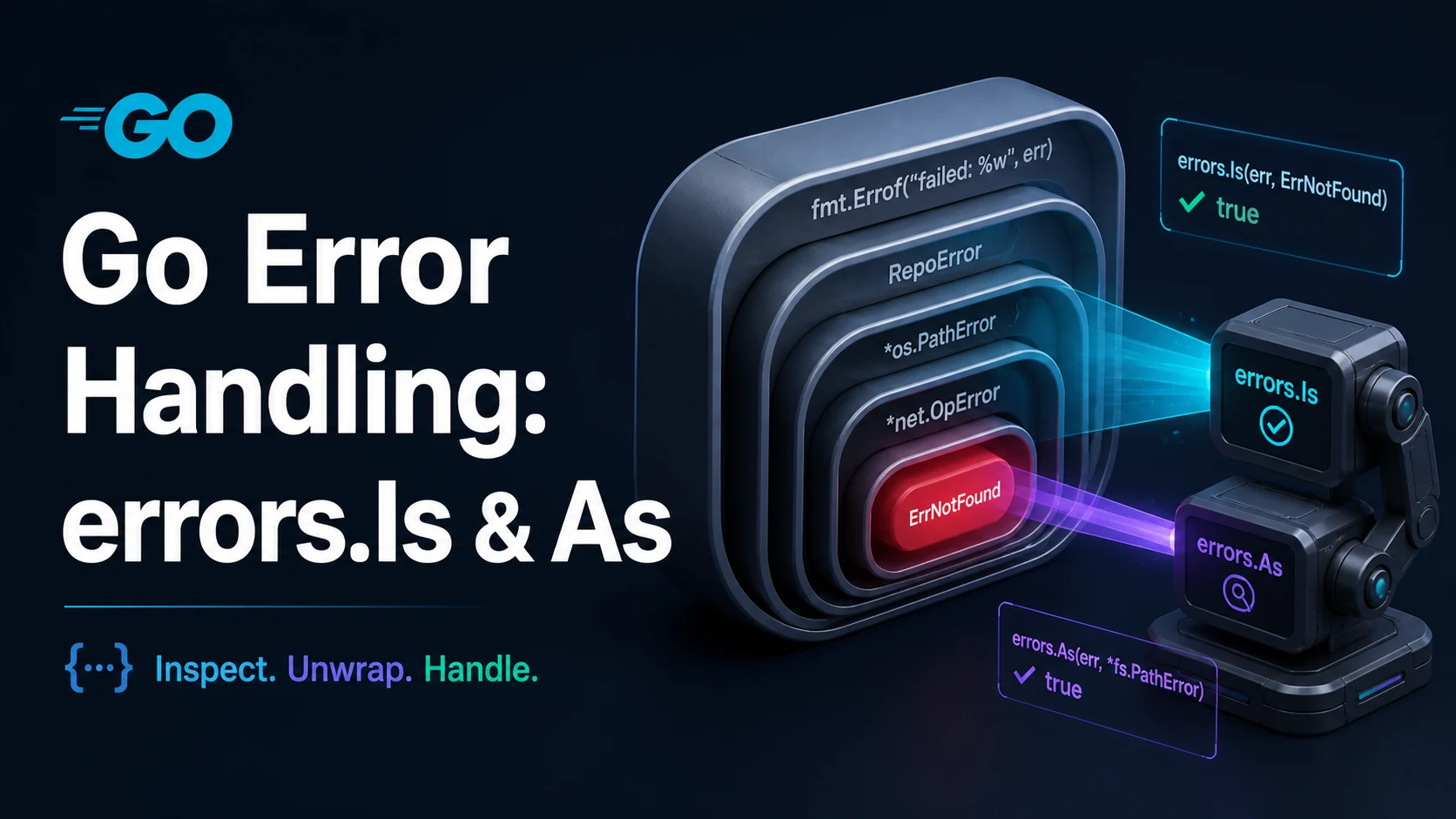
An error in Go is a value, and handling one well is mostly a question of what you compare it against. errors.Is asks "is this error, or anything it wraps, that sentinel?" and errors.As asks "does this chain contain a value of that type, so I can read its fields?" Before Go 1.13 the same checks were string comparisons and type assertions on the outermost error, which broke the moment anyone added context with fmt.Errorf. The two functions exist to make wrapping transparent, and they only work if the wrapping used %w.
Quick Summary
erroris an interface with one method,Error() string. Any type with it is an error, including a struct with fields, which a string cannot carry.- Sentinel errors are package-level values (
var ErrNotFound = errors.New("not found")) meant to be compared, not printed. fmt.Errorf("...: %w", err)keeps the chain;%vcopies the message and destroys it. Since Go 1.20 a singleErrorfcan wrap several errors with multiple%wverbs.- Use
errors.Isfor identity,errors.Asfor type and data.==only works while nothing has wrapped the error. - The target of
errors.Asmust be a non-nil pointer:var e *QueryError; errors.As(err, &e). Passing the value, or a pointer to the wrong type, panics. errors.Unwrapwalks one link,errors.Join(1.20) merges independent errors into a tree, and bothIsandAstraverse the whole tree.- An error type can define
Is(target error) bool(andAs) to answer matches itself, which is how wrapped errors compare by code rather than by pointer.
Basic syntax and type signatures
var (
	ErrNotFound  = errors.New("not found")
	ErrForbidden = errors.New("forbidden")
)

// A typed error carries data a sentinel cannot.
type ValidationError struct {
	Field string
	Rule  string
}

func (e *ValidationError) Error() string {
	return fmt.Sprintf("validation failed: %s violates %s", e.Field, e.Rule)
}

func load(id string) (User, error) {
	raw, err := os.ReadFile("data/" + id + ".json")
	if err != nil {
		// %w keeps the chain: errors.Is(err, fs.ErrNotExist) still works.
		return User{}, fmt.Errorf("load user %s: %w", id, err)
	}
	if len(raw) == 0 {
		return User{}, fmt.Errorf("load user %s: %w", id, ErrNotFound)
	}
	var u User
	if err := json.Unmarshal(raw, &u); err != nil {
		return User{}, fmt.Errorf("decode user %s: %w", id, err)
	}
	return u, nil
}

func handler(id string) error {
	u, err := load(id)
	switch {
	case errors.Is(err, fs.ErrNotExist), errors.Is(err, ErrNotFound):
		return nil // treat as absent
	case err != nil:
		return fmt.Errorf("handler: %w", err)
	}
	_ = u
	return nil
}

func annotate(err error) error {
	var ve *ValidationError
	if errors.As(err, &ve) {
		return fmt.Errorf("field %q: %w", ve.Field, err)
	}
	return err
}
The switch order is the practical rule: test nil last or first depending on your style, but test specific sentinels before a generic err != nil, because once you return the generic error the specific case is gone.
Comparison and traversal side by side
| Function | Question | Target | Follows wrapping |
|---|---|---|---|
err == ErrX | is it exactly that value | comparable error value | no |
errors.Is(err, ErrX) | is it or does it wrap that value | value, and Is methods honoured | yes, all branches |
errors.As(err, &target) | does the chain hold that type | non-nil pointer to error type or interface | yes, all branches |
errors.Unwrap(err) | one level down | — | one link only |
errors.Join(a, b) | merge independent errors | — | creates Unwrap() []error |
err.Error() == "..." | text match | — | no, and brittle |
errors.Is does not simply call ==. It walks the chain, and at each node it first checks for an Is(error) bool method on the node, then falls back to equality when the target's type is comparable. That method is what lets an error compare equal to a sentinel without holding the sentinel's pointer.
Practical edge cases and deep dives
1. A custom Is for errors that carry a code
type QueryError struct {
	Code int
	Op   string
}

func (e *QueryError) Error() string { return fmt.Sprintf("%s: code %d", e.Op, e.Code) }

var ErrConflict = errors.New("conflict")

// Is lets errors.Is(err, ErrConflict) match any QueryError with code 409,
// even after the error has been wrapped several times.
func (e *QueryError) Is(target error) bool {
	if target == ErrConflict {
		return e.Code == http.StatusConflict
	}
	return false
}

func main() {
	err := fmt.Errorf("save: %w", &QueryError{Code: 409, Op: "insert"})
	fmt.Println(errors.Is(err, ErrConflict)) // true
}
This is the pattern that keeps a package's API stable: callers depend on ErrConflict, not on the numeric code, and a later change from 409 to another representation only touches the Is method. The method must not call errors.Is on itself, or the walk recurses; it receives the target and answers directly.
2. errors.As with pointers, interfaces, and the panic
type Timeout interface{ Timeout() bool }

func classify(err error) string {
	// Type target: pointer to a struct that implements error.
	var ve *ValidationError
	if errors.As(err, &ve) {
		return "validation:" + ve.Field
	}

	// Interface target: pointer to an interface, matches by method set.
	var t Timeout
	if errors.As(err, &t) {
		return fmt.Sprintf("timeout:%v", t.Timeout())
	}

	// A pointer to the error interface matches every non-nil error.
	var anyErr error
	if errors.As(err, &anyErr) {
		return "some error: " + anyErr.Error()
	}
	return "none"
}
errors.As assigns the first match into the pointer's target and stops. Three mistakes account for nearly every panic at this call: passing ve instead of &ve (Go 1.21+ reports "errors: target must be a non-nil pointer to either a type that implements error, or to any interface type"), declaring var ve ValidationError and passing &ve when Error() has a pointer receiver (the type does not implement error, so the panic fires), and reusing one target across several As calls while assuming it holds the last match — it holds the first, because the walk stops there.
3. Multiple %w, errors.Join, and reporting several failures
func (v *Validator) Check(in Input) error {
	var errs []error
	if in.Name == "" {
		errs = append(errs, &ValidationError{Field: "name", Rule: "required"})
	}
	if in.Email == "" {
		errs = append(errs, &ValidationError{Field: "email", Rule: "required"})
	}
	return errors.Join(errs...) // nil when errs is empty
}

func save(in Input) error {
	if err := validate(in); err != nil {
		// Both wrapped errors stay reachable through the tree.
		return fmt.Errorf("save: %w", err)
	}
	if err := store(in); err != nil {
		return fmt.Errorf("save: %w", err)
	}
	return nil
}

// Later, one check finds the first validation failure:
var ve *ValidationError
if errors.As(saveErr, &ve) { /* ve.Field is "name" */ }
errors.Join returns nil when every argument is nil, which is why it can be the last statement of a validator without a length check. Its Error() method joins the messages with newlines, and Unwrap() []error makes Is and As fan out over every branch, so a single errors.As finds the first validation error in declaration order. Since Go 1.20, fmt.Errorf with more than one %w builds the same shape, which is useful when one step fails for two independent reasons.
4. Wrapping at the boundary without leaking internal types
// Internal detail: drivers return *pgconn.PgError.
func repo(ctx context.Context, id string) (User, error) {
	var u User
	err := db.QueryRow(ctx, "select ...", id).Scan(&u.ID, &u.Name)
	if err != nil {
		if pgErr, ok := err.(*pgconn.PgError); ok && pgErr.Code == "23505" {
			return User{}, fmt.Errorf("insert user: %w", ErrConflict)
		}
		return User{}, fmt.Errorf("select user %s: %w", id, err)
	}
	return u, nil
}
The boundary translates one vocabulary into another: the driver's error code becomes ErrConflict, and everything else is wrapped with enough context to locate the call in a log without losing the original. Callers above the repository never import the driver's package, and the repository does not need a custom Is method because it already returns the sentinel it wants to be matched on. Wrapping the same error twice with the same message prefix is the sign this translation is missing — the log then reads save: insert user: select user u1: ... with three layers that all say who was doing what.
Common mistakes and compiler errors
| Symptom | Cause | Fix |
|---|---|---|
errors.Is is false after wrapping | the wrap used %v or errors.New(err.Error()) | use %w |
x.(*MyErr) fails after wrapping | assertion only sees the outermost error | errors.As |
| panic: target must be a non-nil pointer | errors.As(err, target) instead of &target | pass the address |
| panic: target must implement error | struct with a pointer-receiver Error() passed by value | pass &value |
errors.As matches the wrong error | var e error; errors.As(err, &e) matches anything | assert the concrete type you need |
errors.Is(err, err) true but nothing else matches | comparing an error to itself by accident | compare against the sentinel |
| wrap disappears at the top level | handler returned errors.New(fmt.Sprint(err)) | return err or wrap with %w |
%w with a nil error | fmt.Errorf("x: %w", nil) yields a non-nil error | check err != nil first |
The habit that prevents most of these is to decide, at each function boundary, whether the caller needs to recognise the failure or merely to report it. Recognition means %w and a sentinel; reporting means any format that reads well. Mixing the two — wrapping with %w and then also matching on err.Error() — produces code that works until a message changes, which is the failure mode errors.Is was introduced to end.
Try matching browser tools
All toolsSmall utilities that fit Go work — they run entirely in this browser tab, so nothing you paste leaves your device.
Related Go guides
All Go guidesGo iota: Enumerations, Bitmask Flags, and Constant Expressions
How iota advances per const line, typed enums with gaps, bit flags with 1 << iota, and the unit scale pattern that shifts with one blank line.
Go JSON: Marshaling, Unmarshaling, Struct Tags, and Custom Parsers
Struct tags, omitempty that skips false and zero, custom marshalers without recursion, RawMessage for tagged unions, and float64 precision loss.
Go Strings, Runes, and Bytes: UTF-8 Encoding, Conversion, and Memory
Bytes versus runes, len that counts bytes, slicing that splits characters, Builder for linear concatenation, and normalization the standard library omits.
Go select Statement: Non-Blocking Operations, Timeouts, and Nil Channels
Random choice among ready cases, non-blocking polls with default, nil channels that disable a case, timer reuse, and labeled breaks out of a loop.
More in Go
All Go guidesThe guides filed next to this one in Go, in library order.