Java Stream Creation: From Collections, Arrays, and Generators
Learn how to create Java streams from collections, arrays, generators, and files, with practical examples and performance tradeoffs.
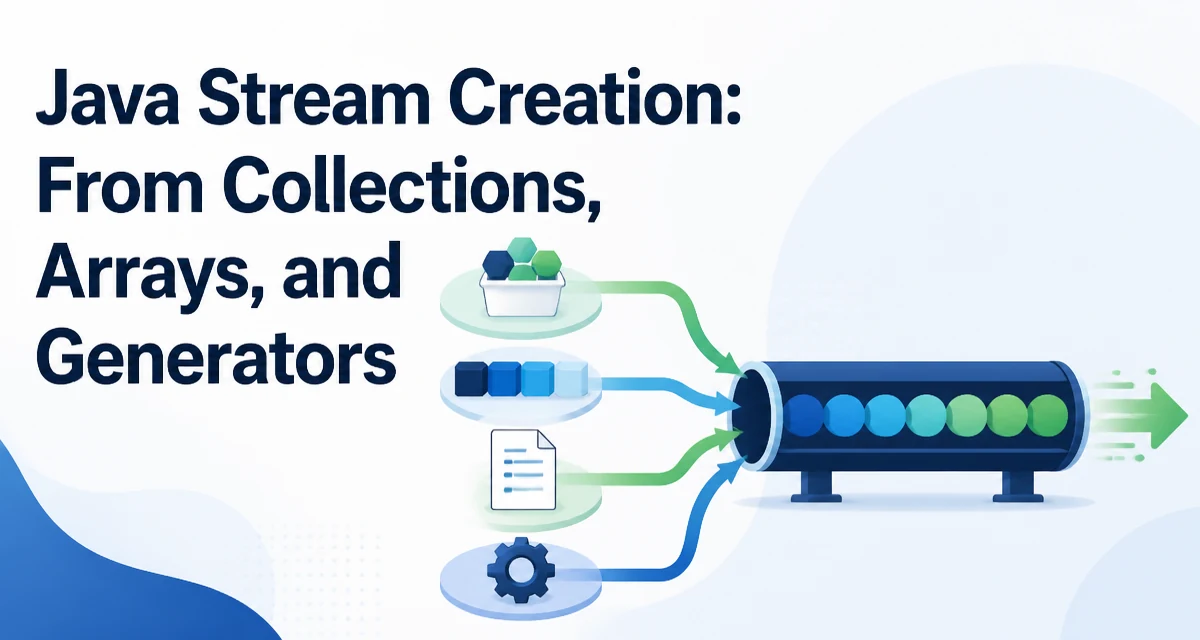
When you need to process a sequence of elements with the Java Stream API, the first step is creating a Stream instance. The creation method you choose depends on the data source and can affect behavior, performance, and resource management. This article covers the main ways to create streams: from collections, arrays, generators, and I/O sources.
Creating a Stream from a Collection
The most common source is any Collection. Calling stream() on a List, Set, or Queue returns a sequential stream. For parallel processing, parallelStream() returns a stream that may run operations concurrently.
List<String> names = Arrays.asList("Ada", "Grace", "Linus");
Stream<String> nameStream = names.stream();
If you need parallel processing, use parallelStream():
Stream<String> parallelNames = names.parallelStream();
Note that a stream from a collection is not a snapshot. If the source collection is modified after the stream is created, the stream does not necessarily reflect those changes, and a terminal operation may throw ConcurrentModificationException.
Creating a Stream from an Array
Arrays do not implement Collection, so they need a different approach. The Arrays.stream() method accepts an array and returns a stream of the element type. For primitive arrays, there are overloads for int, long, and double.
String[] tags = {"java", "stream", "api"};
Stream<String> tagStream = Arrays.stream(tags);
For primitive arrays, you get IntStream, LongStream, or DoubleStream:
int[] numbers = {1, 2, 3};
IntStream intStream = Arrays.stream(numbers);
Using Stream.of() for a Fixed Set of Elements
When you have a handful of values and no collection, Stream.of() is the simplest way. It accepts varargs, so you can pass individual elements. For objects, it returns a Stream<T>. For primitives, use IntStream.of(), LongStream.of(), and DoubleStream.of().
Stream<String> colors = Stream.of("red", "green", "blue");
IntStream scores = IntStream.of(90, 85, 95);
For an object array, Stream.of(array) returns a stream of the array's elements because the varargs parameter expands the array. For example, Stream.of(tags) for a String[] returns Stream<String>. For a primitive array, however, Stream.of(array) treats the array as a single element and returns Stream<int[]> (or Stream<long[]> and so on). Use Arrays.stream() for arrays, especially primitive arrays.
Generating Streams with iterate() and generate()
For infinite or lazily produced sequences, Stream.iterate() and Stream.generate() create unbounded streams. iterate() starts with a seed and applies a unary operator to produce the next value. generate() takes a Supplier and produces values indefinitely.
Stream<Long> evenNumbers = Stream.iterate(0L, n -> n + 2);
Stream<Double> randomDoubles = Stream.generate(Math::random);
The iterate() and generate() examples above are infinite streams, so you must apply a limit() operation before a terminal operation to avoid an endless loop.
evenNumbers.limit(10).forEach(System.out::println);
Java 9 added an overloaded iterate() that stops when a predicate is false:
Stream.iterate(0, n -> n < 100, n -> n + 1)
This is useful for bounded sequences without manually calling limit().
Creating Streams from Files and I/O Sources
The Files.lines() method returns a Stream<String> of lines from a file. This stream must be closed after use because it holds an open file handle. Typically, you use try-with-resources to ensure proper cleanup.
try (Stream<String> lines = Files.lines(Paths.get("data.txt"))) {
    lines.filter(line -> !line.isBlank())
         .forEach(System.out::println);
} catch (IOException e) {
    // handle exception
}
Similarly, BufferedReader.lines() gives a stream of lines from any reader. The same resource management applies.
If you use isBlank(), keep in mind that this method was added in Java 11. On earlier Java versions, you can use !line.trim().isEmpty() instead.
Primitive Streams and Ranges
For numeric ranges, IntStream.range() and LongStream.range() generate a sequential stream of numbers. range() is exclusive of the end, rangeClosed() is inclusive.
IntStream.range(1, 5) // 1,2,3,4
IntStream.rangeClosed(1, 5) // 1,2,3,4,5
These are handy for loops and index-based operations. You can also use IntStream.of() to create a stream from a fixed set of ints.
Performance and Resource Considerations
Stream creation is generally cheap, but the source matters. For collections, stream() simply wraps the collection's spliterator, so it has minimal overhead. For arrays, Arrays.stream() creates a spliterator over the array, also efficient. For infinite streams, be careful with limit() and short-circuiting operations; they prevent unnecessary computation.
Resource management is critical for I/O-based streams. Files.lines() and BufferedReader.lines() return streams that must be closed. Failing to close them leaks file descriptors. Always use try-with-resources.
Also note that streams are single-use. You cannot reuse a stream after a terminal operation. Recreating a stream from a collection is cheap, but from a file you need to reopen it.
For large data sets, parallelStream() can improve throughput, but it adds overhead and ordering guarantees change. Only use parallel when the stream operations are independent and the data size justifies it.