Python Decorator vs Context Manager: Key Differences
Understand the differences between Python decorators and context managers, when to use each, and how to combine them for cleaner resource handling.
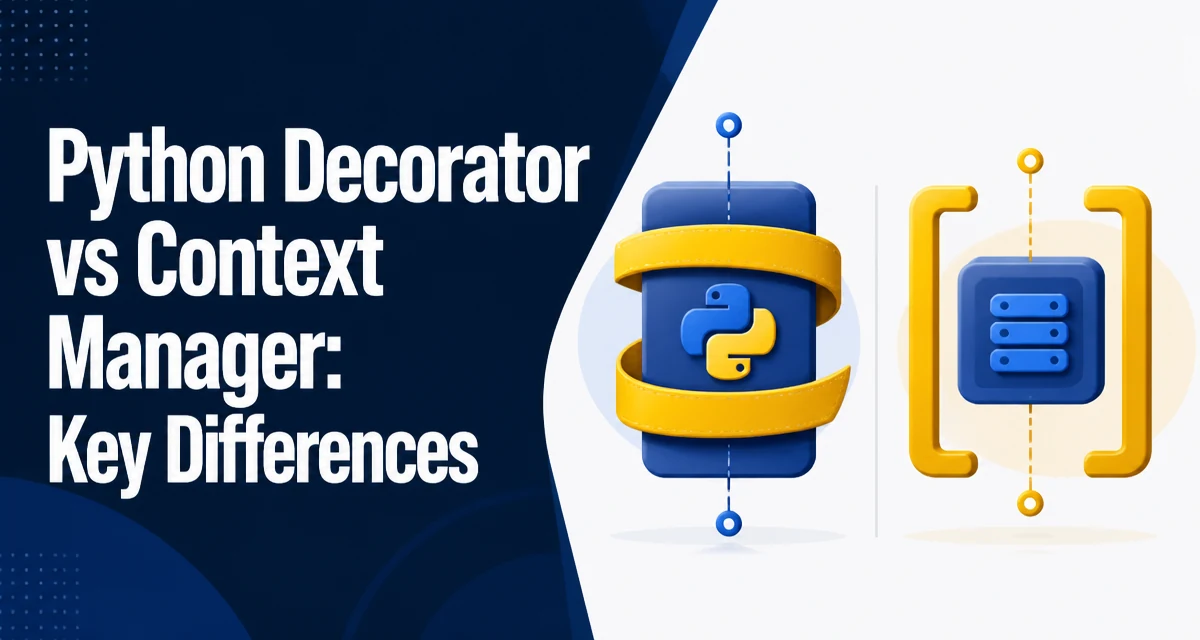
When writing Python, you often need to wrap logic—either to transform a function or to manage a resource's lifecycle. The two primary tools are decorators and context managers. This article compares them so you can decide which fits your situation.
What a Decorator Does
A decorator is a function that takes another function (or method) and returns a new one, usually extending its behavior. The classic use is to add cross-cutting concerns like logging, timing, or access control without modifying the original function's body.
import functools
import time

def timed(func):
    @functools.wraps(func)
    def wrapper(*args, **kwargs):
        start = time.perf_counter()
        result = func(*args, **kwargs)
        elapsed = time.perf_counter() - start
        print(f"{func.__name__} took {elapsed:.4f}s")
        return result
    return wrapper

@timed
def process_data(data):
    # simulate work
    return [x * 2 for x in data]
The decorator wraps the function, runs extra code before and after the call, and returns the result. The original function's name and metadata are preserved via functools.wraps.
What a Context Manager Does
A context manager is an object that defines __enter__ and __exit__ methods, used with the with statement. The @contextlib.contextmanager decorator provides a shorter way to create one from a generator function. A context manager guarantees that setup and cleanup code runs around a block, even if an exception occurs. The typical use is resource management: files, locks, database connections, or temporary state.
class ManagedFile:
    def __init__(self, filename, mode):
        self.filename = filename
        self.mode = mode

    def __enter__(self):
        self.file = open(self.filename, self.mode)
        return self.file

    def __exit__(self, exc_type, exc_val, exc_tb):
        self.file.close()

with ManagedFile("data.txt", "w") as f:
    f.write("hello")
The with statement calls __enter__, assigns its return value to the target, and guarantees __exit__ runs when the block ends—whether normally or via an exception. This is built on the same mechanism as try/finally, but it packages setup and cleanup into a reusable object, so the cleanup logic does not have to be duplicated at each call site.
Core Differences in Syntax and Purpose
Decorators and context managers serve different purposes, and their syntax reflects that.
| Aspect | Decorator | Context Manager |
|---|---|---|
| Syntax | @decorator above a function | with context_mgr as target: |
| Scope | Wraps an entire function or method | Wraps a block of code (often inside a function) |
| Timing | Runs before and after the function call | Runs __enter__ before the block, __exit__ after |
| Typical use | Transform function behavior, add logging, caching, validation | Manage resources, set up/tear down state, handle transactions |
| Reusability | Decorator can be applied to many functions | Context manager can be used in many with blocks |
A decorator is applied at definition time and affects every call to the function. A context manager is applied at execution time and affects only the enclosed block. This distinction is fundamental when choosing which tool to use.
When to Use a Decorator
Use a decorator when you want to modify the behavior of a function or method consistently across your codebase. Common scenarios:
- Logging: Record function calls, arguments, and return values.
- Timing: Measure execution time for profiling.
- Caching: Memoize results based on arguments.
- Access control: Check permissions before allowing execution.
- Validation: Verify inputs or outputs against a schema.
Decorators are ideal when the logic is tightly coupled to the function's lifecycle—every invocation should go through the wrapper. They keep the function's core logic clean and separate the cross-cutting concern.
When to Use a Context Manager
Use a context manager when you need to acquire and release a resource or set up and tear down a specific state around a block of code. Typical scenarios:
- File I/O: Open/close files, even on exceptions.
- Locks: Acquire/release threading locks.
- Database connections: Commit/rollback transactions.
- Temporary changes: Modify global state (e.g., environment variables) and restore it.
- Timing a block: Measure elapsed time for a specific section, not a whole function.
Context managers shine when the resource lifecycle is independent of function boundaries. For example, you might want to acquire a lock only for a few lines, not the entire function. A decorator would force the lock to wrap the whole function call.
Combining Decorators and Context Managers
These tools are not mutually exclusive. A decorator can internally use a context manager to achieve its effect. This is a common pattern for timing or resource setup.
import contextlib
import functools
import time

def timed_with_context(func):
    @functools.wraps(func)
    def wrapper(*args, **kwargs):
        with time_block():
            return func(*args, **kwargs)
    return wrapper

@contextlib.contextmanager
def time_block():
    start = time.perf_counter()
    try:
        yield
    finally:
        print(f"Elapsed: {time.perf_counter() - start:.4f}s")
Here, the decorator wraps the function, and inside the wrapper, a context manager handles the timing. This combines function-level wrapping with block-level resource management. The contextlib.contextmanager decorator is a convenient way to create a context manager from a generator function.
The same pattern works for resources whose cleanup must happen even when the wrapped function raises an exception. For example, a decorator can make every call to a function run inside a database transaction:
import functools
import sqlite3
from contextlib import contextmanager

@contextmanager
def db_transaction(conn):
    try:
        yield
        conn.commit()
    except Exception:
        conn.rollback()
        raise

def transactional(func):
    @functools.wraps(func)
    def wrapper(conn, *args, **kwargs):
        with db_transaction(conn):
            return func(conn, *args, **kwargs)
    return wrapper

@transactional
def insert_user(conn, name):
    cur = conn.cursor()
    cur.execute("INSERT INTO users (name) VALUES (?)", (name,))
Here, the decorator ensures every call to insert_user runs inside a transaction, and the context manager handles commit/rollback. This separation keeps the database logic in the function and the transaction management in a reusable component.
Choosing the Right Tool for Your Code
The decision between a decorator and a context manager comes down to the scope of the behavior. If you need to apply the same logic to entire functions or methods, a decorator is the natural choice. If you need to manage a resource or state around a specific block—possibly inside a function—a context manager is more precise.
There's also a hybrid approach: use a context manager inside a decorator to get both function-level wrapping and block-level resource control. This is common in libraries that expose the same behavior as both a decorator and a context manager.
Consider the readability and maintenance implications. Decorators can hide execution flow, making debugging harder if overused. Context managers make resource lifecycle explicit, which is easier to reason about. In general, prefer the simplest tool that clearly expresses the intent. For function-wide concerns, use a decorator. For block-scoped resource management, use a context manager. When you need both, combine them deliberately.
A final note: both tools rely on Python's dynamic nature. A decorator is just a function call that returns a callable, and a context manager is an object with __enter__ and __exit__ methods (or a generator function decorated with @contextmanager). Understanding these underlying mechanisms helps you debug and extend them when needed. The contextlib module provides utilities like closing, suppress, and ExitStack that can simplify complex resource management without writing custom classes.
By matching the tool to the scope of the behavior, you keep your codebase clean, testable, and maintainable.