Python Dict Comprehension vs Dict Constructor
Compare Python dict comprehensions and the dict() constructor: syntax, readability, performance, and when to use each.
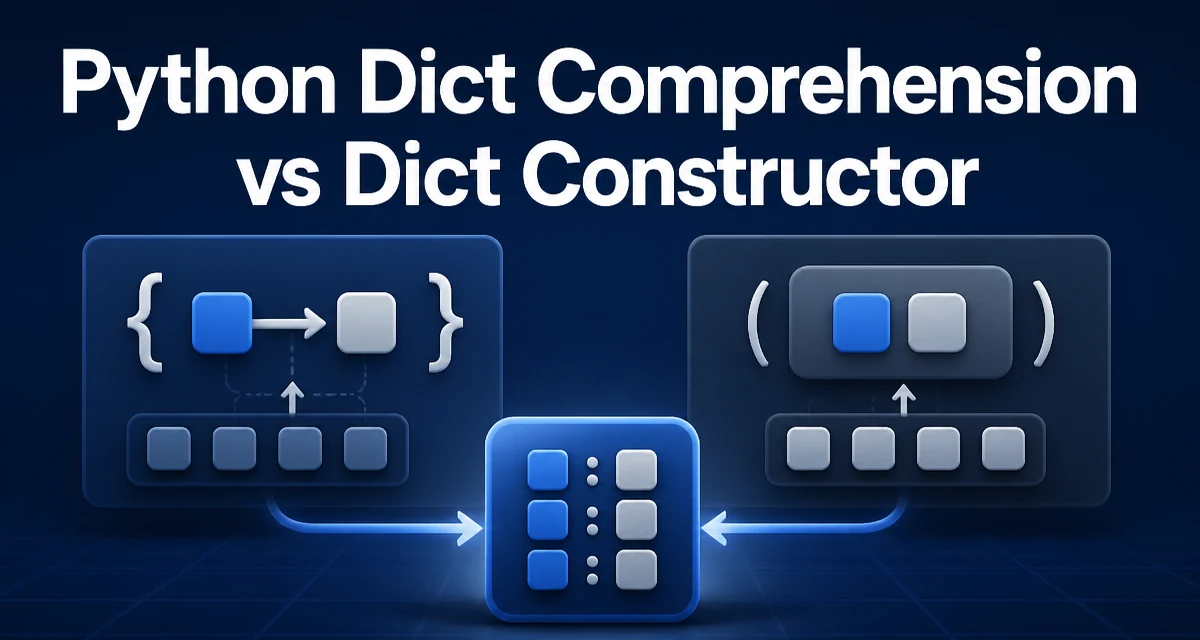
When you need to build a dictionary in Python, you have two primary tools: a dict comprehension and the dict() constructor. The choice between these approaches often comes down to the shape of your input data and whether you need to transform it. This article compares their behavior, readability tradeoffs, and the practical rules that should guide your decision.
What a Dict Comprehension Actually Does
A dict comprehension builds a dictionary by iterating over an iterable and applying an expression to each item. The syntax uses curly braces with a key-value pair separated by a colon:
squares = {x: x**2 for x in range(5)}
# {0: 0, 1: 1, 2: 4, 3: 9, 4: 16}
Here, x is the key and x**2 is the value. The comprehension evaluates the key and value expressions for each element of the iterable, then inserts the result into a new dictionary. This is conceptually similar to a for loop, but it is more compact and often avoids repeated method calls.
The iterable can be any iterable, including lists, tuples, sets, or even another dictionary. When you iterate over a dictionary, you get its keys, which is a common pattern:
original = {'a': 1, 'b': 2}
doubled = {k: v * 2 for k, v in original.items()}
# {'a': 2, 'b': 4}
The comprehension gives you full control over both the key and the value expressions. You can filter items with an if clause, which is more direct than the constructor's iterable-of-pairs form:
filtered = {k: v for k, v in original.items() if v > 1}
This makes the comprehension the natural choice when you need to derive keys or values from an existing iterable, apply a transformation, or conditionally include items.
What the dict Constructor Accepts
The dict() constructor creates a dictionary from one of three forms: a mapping object, an iterable of key-value pairs, or keyword arguments. Each form has specific constraints.
From a mapping:
dict({'a': 1, 'b': 2})
# {'a': 1, 'b': 2}
This is essentially a shallow copy of the mapping. It is the simplest way to duplicate a dictionary when you do not need to change its contents.
From an iterable of key-value pairs:
dict([('a', 1), ('b', 2)])
# {'a': 1, 'b': 2}
The iterable must yield pairs of two elements. Each pair becomes one key-value entry. This works with any iterable of pairs, including a list of tuples, a generator of tuples, or a list of lists.
From keyword arguments:
dict(a=1, b=2)
# {'a': 1, 'b': 2}
This form is convenient for small, hard-coded dictionaries, but it only works when the keys are valid Python identifiers. You cannot use it to create keys with spaces, hyphens, or other characters that are not allowed in variable names.
A key limitation of the constructor is that it does not apply any transformation to the keys or values. It simply takes what you give it and inserts it as-is. If you need to compute keys or values, you have to precompute the data outside the constructor, which often leads to less readable code.
Comparing Syntax and Readability
Consider a common task: convert a list of strings into keys, with the string length as the value. With a comprehension, this is direct:
words = ['apple', 'banana', 'cherry']
lengths = {word: len(word) for word in words}
If you use the constructor instead, you must build an iterable of pairs yourself. One way is to use a generator expression:
lengths = dict((word, len(word)) for word in words)
Both produce the same dictionary, but the comprehension is more immediately readable. The generator expression introduces an extra layer of parentheses and an explicit tuple, which adds cognitive overhead. The comprehension clearly shows the key-value relationship at a glance.
However, the constructor shines when you already have a list of pairs. For example, when reading data from a CSV file or a database cursor, you often get rows as tuples. If the data is already in the correct shape, the constructor is the more direct tool:
pairs = [('id', 1), ('name', 'Alice')]
record = dict(pairs)
A comprehension would require unpacking the pair and rebuilding it, which is unnecessary:
record = {k: v for k, v in pairs} # works but is redundant
In this case, the constructor expresses intent better: "I have a sequence of key-value pairs and want a dictionary from it." The comprehension adds no value because there is no transformation.
Performance Differences and When They Matter
Performance is often a deciding factor, but the differences are rarely large enough to matter unless you are building many dictionaries. The underlying mechanisms are what matter.
In CPython, a dict comprehension is compiled to bytecode that builds the dictionary directly. The constructor with an iterable of pairs must iterate over the pairs and insert each one. When the comprehension computes key and value expressions, it also avoids creating an intermediate tuple for each item, which a generator expression creates before dict() consumes it.
Consider two approaches for building a dictionary from a list of integers:
# Comprehension
squares = {x: x*x for x in range(1000)}

# Constructor with generator
squares = dict((x, x*x) for x in range(1000))
The generator expression creates a tuple (x, x*x) for each element, then the constructor unpacks that tuple. The comprehension avoids the intermediate tuple, so it can be slightly faster and use less memory for large inputs. However, the difference is usually negligible in application code. It becomes measurable only when you are creating large dictionaries in a tight loop, and even then the result depends on the Python implementation and version.
There is no universal rule that one is always faster. When you already have a list of pairs, dict(pairs) can copy them directly without evaluating key or value expressions. When you need to compute keys or values from an existing iterable, a comprehension avoids an extra generator layer.
If performance is critical, profile your specific use case. In most application code, readability and maintainability should drive the choice. Premature optimization with one method over the other rarely yields meaningful gains.
Common Mistakes and Edge Cases
Both approaches have pitfalls that can lead to bugs or unexpected behavior.
Using the constructor with a bare iterable of keys is a common mistake. If you pass a list of single-character strings, you get an error:
dict(['a', 'b'])
# ValueError: dictionary update sequence element #0 has length 1; 2 is required
The constructor expects each element to be a pair. If you want to initialize a dictionary with keys and a default value, use dict.fromkeys() instead:
dict.fromkeys(['a', 'b'], 0)
# {'a': 0, 'b': 0}
A comprehension does not have this issue because you explicitly define the key and value expressions.
Duplicate keys behave the same way in both approaches: the last occurrence wins. In a comprehension, if the iterable yields the same key multiple times, the last value overwrites the previous one. The constructor behaves identically when given a list of pairs. This is not a difference, but it is worth remembering when building from data that may contain duplicates.
Keyword arguments in the constructor cannot be used with dynamic keys. If your keys come from variables, you must use the mapping or iterable form. For example:
key = 'name'
value = 'Alice'
# This fails: dict(key=value) creates a key literally named 'key'
# Instead use: dict([(key, value)])
A comprehension handles dynamic keys naturally, but it is often overkill; the constructor with a list of pairs is cleaner. The point is that each approach has its own constraints.
Nested comprehensions can become hard to read. If you need to build a dictionary of dictionaries, a comprehension can be used, but it may be more maintainable to use a loop. The constructor does not help here either; it is not designed for complex transformations.
Choosing Between Them in Real Code
A practical rule of thumb is to use a dict comprehension when you need to transform or filter an existing iterable, and use the constructor when you already have a mapping or an iterable of pairs.
Here are concrete decision criteria:
- Use a comprehension when you are computing keys or values from another iterable, applying a function, or filtering items.
- Use the constructor when you have a list of tuples, a dictionary to copy, or a small set of hard-coded key-value pairs that fit as keyword arguments.
- Use
dict.fromkeys()when you need a dictionary with a fixed set of keys and a default value.
Consider a scenario where you read a CSV file and want a dictionary mapping column names to the first row of values. If the data is already in a list of pairs, the constructor is the obvious choice:
columns = ['id', 'name', 'email']
first_row = [1, 'Alice', 'alice@example.com']
record = dict(zip(columns, first_row))
Here, zip produces the pairs, and dict consumes them directly. A comprehension would be redundant.
On the other hand, if you need to invert a dictionary (swap keys and values), a comprehension is the standard approach:
original = {'a': 1, 'b': 2}
inverted = {value: key for key, value in original.items()}
The constructor can do this with a generator expression, but the result is less readable.
When the Constructor Is Less Direct: Computed Keys and Values
The constructor is most awkward when you need to generate keys and values from a complex expression during iteration. For example, building a dictionary that maps each character in a string to its frequency is cleaner with a comprehension:
word = 'hello'
freq = {char: word.count(char) for char in set(word)}
You can force this into dict() with a generator expression, but doing so amounts to writing the same logic with extra parentheses:
freq = dict((char, word.count(char)) for char in set(word))
Similarly, if you need to conditionally include items based on a predicate, the comprehension's if clause is the clearest syntax. The constructor has no dedicated filter, so the condition must be folded into a generator expression:
filtered = dict((k, v) for k, v in original.items() if v > 1)
In cases like these, the comprehension is usually the more idiomatic choice, even though the constructor can be made to work.
Maintainability and Readability Tradeoffs
Readability is often the deciding factor in production code. A comprehension that is longer than a few lines becomes hard to follow. If you find yourself writing a comprehension with complex expressions or multiple conditions, consider breaking it into a loop with explanatory variable names.
For example, this comprehension is dense:
result = {k: transform(v) for k, v in data.items() if condition(k) and other(v)}
It may be clearer as a loop:
result = {}
for k, v in data.items():
    if condition(k) and other(v):
        result[k] = transform(v)
The loop is more verbose but easier to debug and modify. The constructor does not offer a middle ground; it is only useful for simple, direct construction.
When you are building a dictionary from a known set of key-value pairs, the constructor with keyword arguments is the most self-documenting form:
config = dict(host='localhost', port=8080, debug=True)
This reads like a set of named parameters, which is clear to anyone familiar with the code. A comprehension would be overkill.
The decision ultimately comes down to the shape of your input and the amount of transformation required. If you are mapping one iterable to another, use a comprehension. If you are assembling a dictionary from pre-existing pairs, use the constructor. This simple rule covers the vast majority of cases and keeps your code idiomatic and maintainable.
One important edge case is when you need to merge multiple dictionaries into one. Neither a comprehension nor the constructor is the best tool; in modern Python, use the {**dict1, **dict2} unpacking syntax, the update() method, or the | operator on Python 3.9+. The comprehension cannot easily merge multiple sources, and the constructor takes at most one mapping or iterable as its positional argument, plus optional keyword arguments, so it is not built for merging multiple arbitrary dictionaries. Knowing when to use neither is part of mastering dictionary creation.
In summary, the choice between a dict comprehension and the dict() constructor is not about which is "better" in absolute terms. It is about matching the tool to the data and the transformation you need. Comprehensions give you expressive power for computed keys and values; the constructor gives you a direct path when the data is already in dictionary-ready form. Understanding both allows you to write code that is both efficient and clear.