Using lambda with map in Python
Combine lambda and map in Python for concise transformations. See syntax, multiple-iterable behavior, performance tradeoffs, and when to use a named function.
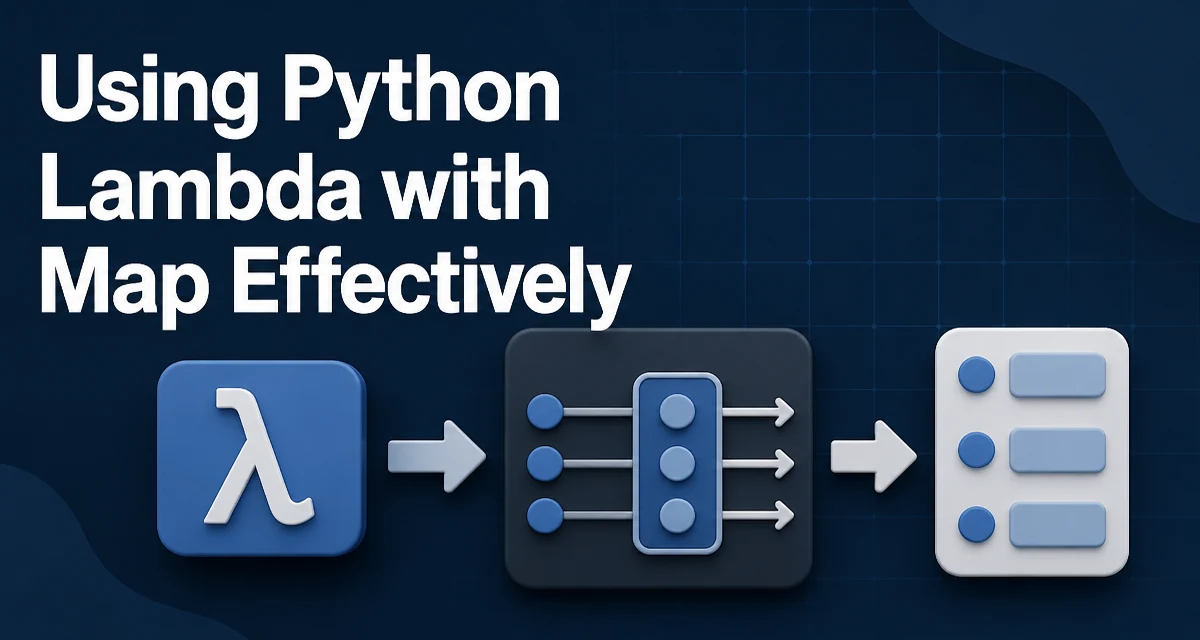
Using a lambda with map is a compact way to apply a small inline function to every item in an iterable without defining a separate named function. The map function accepts a callable and one or more iterables, then returns an iterator that yields the results. When the callable is a lambda, you can express simple transformations in a single line, useful for data cleaning, type conversion, and quick calculations.
How map and lambda Work Together
The map function in Python has the signature map(function, iterable, ...). It applies function to each item of the iterable and returns a map object, which is a lazy iterator. A lambda is an anonymous function defined inline with the syntax lambda arguments: expression. Combining them lets you avoid defining a separate def function when the logic is trivial.
numbers = [1, 2, 3, 4]
squared = map(lambda x: x ** 2, numbers)
print(list(squared))  # [1, 4, 9, 16]
Here, the lambda takes each x and returns x ** 2. The map object is converted to a list for display. Because map is lazy, the transformation happens only when you iterate over it, not when you call map.
Passing Multiple Iterables to map
map can accept more than one iterable. When you pass multiple iterables, the function must accept that many arguments. The iteration stops when the shortest iterable is exhausted. This is useful for combining elements from parallel sequences.
list1 = [1, 2, 3]
list2 = [10, 20, 30]
result = map(lambda a, b: a + b, list1, list2)
print(list(result))  # [11, 22, 33]
If the iterables have different lengths, the result is truncated to the length of the shortest one. For example, list1 with three elements and list2 with five will only produce three results. This stopping behavior matches Python's zip, but map passes the items from each iterable as separate arguments to the callable.
Using lambda with map for Type Conversion
A common use case is converting a collection of strings to integers or floats. A lambda can wrap int() or float() with string preprocessing, such as removing a thousands separator before conversion.
values = ['1,000', '2,500', '3,200']
cleaned = map(lambda s: int(s.replace(',', '')), values)
print(list(cleaned))  # [1000, 2500, 3200]
This is more flexible than passing int directly because you can chain string methods before the conversion. If the strings are already in a form int() accepts, passing the built-in function itself is clearer: map(int, values). The lambda becomes useful when you need to combine operations or handle formatting that the built-in function does not support.
Handling None Return Values and Edge Cases
Because map applies the function to every element, you must handle cases where the function returns None or raises an exception. A lambda that returns None will produce None values in the output. For example, a conditional transformation might return None for certain inputs.
result = map(lambda x: x if x > 0 else None, [-1, 2, 0, 3])
print(list(result))  # [None, 2, None, 3]
If the lambda can raise an exception (e.g., int('abc')), the exception propagates when the map object is iterated. There is no built-in error handling in map; you need to wrap the lambda with a try-except block if you expect invalid data. For instance, you could define a helper function that catches ValueError and returns a default, but that defeats the brevity of a lambda. In such cases, a named function is often more maintainable.
Performance and Memory: map vs List Comprehension
A frequent decision is whether to use map with a lambda or a list comprehension. Both produce a sequence of transformed values, but they differ in laziness and speed. map returns an iterator, so it does not build a list until you consume it. A list comprehension always builds a list immediately. This affects memory usage when dealing with large iterables.
# map: lazy iterator
mapped = map(lambda x: x * 2, range(1000000))

# list comprehension: eager list
comp = [x * 2 for x in range(1000000)]
The map version consumes far less memory because it does not store all results at once. However, if you need a list anyway, the list comprehension is often faster because it avoids the overhead of a function call per item. In CPython, a lambda call is usually more expensive than an inlined expression in a comprehension. For small datasets, the difference is negligible, but for large ones, a list comprehension with a simple expression can be noticeably faster.
The following table summarizes the tradeoffs:
| Aspect | map + lambda | List Comprehension |
|---|---|---|
| Return type | Iterator (lazy) | List (eager) |
| Memory usage | Low for large inputs | High if input is large |
| Speed (CPython) | Slower due to function call overhead | Faster for simple expressions |
| Readability | Good for trivial logic | Better for complex logic |
| Multiple inputs | Built-in support | Requires zip or nested loops |
If you need to pass more than one iterable, map is more natural than a comprehension with zip, though you can write [a + b for a, b in zip(list1, list2)]. The choice depends on whether you want a lazy iterator or an eager list, and whether the transformation is simple enough that a lambda does not hurt readability.
When to Avoid lambda with map
While lambda with map is concise, it can harm readability when the logic is complex. A lambda with multiple expressions, conditionals, or side effects becomes hard to read and debug. Python's style guidance favors readable, explicit code; for non-trivial logic, that usually means a named function rather than a dense lambda. For example, a transformation that requires multiple steps is better written as a def function and passed to map directly.
# Less readable
transformed = map(lambda x: x.strip().lower().replace(' ', '_'), names)

# More readable
def clean_name(name):
    return name.strip().lower().replace(' ', '_')

transformed = map(clean_name, names)
The lambda version is acceptable for a one-off script, but in a codebase that others maintain, a named function provides a clear name and is easier to unit test. Additionally, if you need to reuse the logic elsewhere, a named function avoids duplication.
Practical Example: Processing Log Lines
Consider a scenario where you have a list of log lines and you want to extract the timestamp and level. For simple, consistent lines, lambda with map is concise.
logs = [
    '2023-01-01 10:00:00 INFO message',
    '2023-01-01 10:01:00 ERROR failure',
]

# Simple split-based extraction
parsed = map(lambda line: line.split()[0:2], logs)
print(list(parsed))
# [['2023-01-01', '10:00:00'], ['2023-01-01', '10:01:00']]
This works because each line has a consistent structure. If the format varies, a more robust parser is needed, and a lambda would become unwieldy. In that case, define a function that handles edge cases and pass it to map. This keeps the transformation logic testable and maintainable.
Compatibility and Python Versions
map and lambda have been part of Python since early versions, and their behavior is stable. In Python 3, map returns an iterator, whereas in Python 2 it returned a list. If you are migrating legacy code, you may need to wrap map with list() to preserve the original behavior. This is a common source of confusion when moving from Python 2 to Python 3. Also, note that lambda cannot contain statements, only expressions. If you need to assign variables or perform multiple actions, use a named function.
For example, you cannot write lambda x: y = x + 1 because assignment is a statement. You would need to use a def function. This limitation often pushes developers to use comprehensions or named functions for anything beyond a simple expression.