Combining Dropout, Batch Normalization, and Learning Rate Schedulers in PyTorch
Learn how to combine dropout, batch normalization, and learning rate schedulers in PyTorch, including layer placement, train/eval modes, scheduler timing, and common pitfalls.
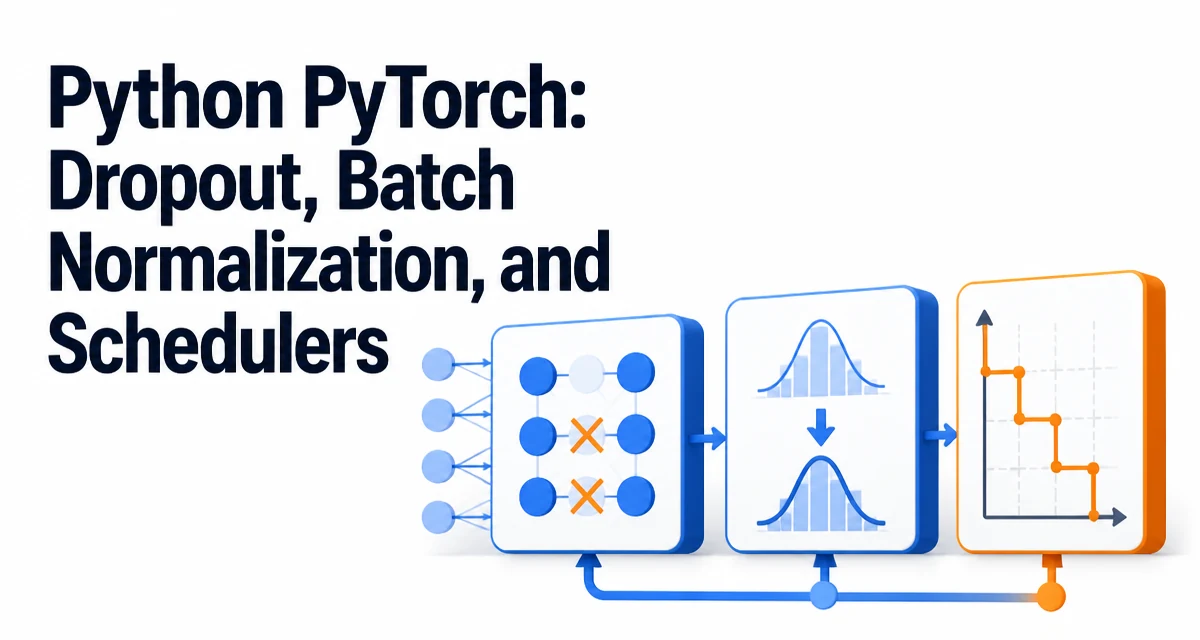
Dropout, batch normalization, and learning rate schedulers affect three different parts of neural network training: regularization, activation stability, and learning-rate control. In PyTorch, each is simple to add, but combining them correctly requires attention to layer placement, train and eval modes, and scheduler timing. This article explains those details and shows a complete training loop.
What Dropout Does in PyTorch
Dropout is a regularization technique that randomly zeroes a fraction of activations during training. In PyTorch, torch.nn.Dropout applies this per sample. The p argument sets the probability of an element being zeroed. For example, nn.Dropout(0.5) drops half of the inputs on average.
import torch.nn as nn

dropout = nn.Dropout(p=0.5)
Dropout is active only when the model is in training mode. Calling model.train() enables it; model.eval() disables it. This behavior is critical when you later combine it with batch normalization, which also changes behavior between modes.
A typical placement is after an activation function and before the next linear or convolutional layer. For convolutional networks, nn.Dropout2d drops entire channels instead of individual pixels, which can be more effective when neighboring activations are highly correlated.
Batch Normalization in PyTorch
Batch normalization normalizes layer activations using the mean and variance of the current batch. In PyTorch, nn.BatchNorm1d and nn.BatchNorm2d are used for fully connected and convolutional layers respectively.
bn = nn.BatchNorm1d(num_features=128)
During training, batch norm normalizes with the current batch's statistics and updates running averages that will be used at evaluation time. During evaluation, it uses those running averages. Therefore, you must switch modes correctly: model.train() during training and model.eval() when evaluating or predicting.
Batch norm is typically placed after a linear or convolutional layer and before the activation function. The order Linear -> BatchNorm -> ReLU is common. Placing dropout after batch norm but before activation is possible, but the exact sequence depends on the architecture.
Learning Rate Schedulers in PyTorch
Learning rate schedulers adjust the optimizer's learning rate during training. PyTorch provides several in torch.optim.lr_scheduler. The most common are StepLR, ReduceLROnPlateau, and CosineAnnealingLR.
import torch.optim as optim
from torch.optim.lr_scheduler import StepLR

optimizer = optim.Adam(model.parameters(), lr=0.001)
scheduler = StepLR(optimizer, step_size=10, gamma=0.1)
StepLR reduces the learning rate by gamma every step_size epochs. ReduceLROnPlateau reduces the rate when a monitored metric stops improving. CosineAnnealingLR follows a cosine curve over a fixed number of epochs.
Schedulers such as StepLR and CosineAnnealingLR are typically stepped once per epoch, after the training loop for that epoch. ReduceLROnPlateau also expects the monitored metric as an argument.
Combining Dropout, Batch Norm, and Schedulers in a Model
A practical model might look like this:
import torch
import torch.nn as nn

class Net(nn.Module):
    def __init__(self):
        super().__init__()
        self.fc1 = nn.Linear(784, 256)
        self.bn1 = nn.BatchNorm1d(256)
        self.drop1 = nn.Dropout(0.3)
        self.fc2 = nn.Linear(256, 10)

    def forward(self, x):
        x = self.fc1(x)
        x = self.bn1(x)
        x = torch.relu(x)
        x = self.drop1(x)
        x = self.fc2(x)
        return x
Here, batch norm is applied before ReLU, and dropout after ReLU. The order is deliberate: batch norm stabilizes the pre-activation distribution, then dropout adds regularization to the activated features.
During training, both dropout and batch norm use their training behavior. During evaluation, call model.eval() so that dropout is disabled and batch norm uses running statistics.
The Training Loop with a Scheduler
A typical training loop combines all three. The scheduler steps after each epoch, and the model switches between train and eval modes appropriately.
model = Net()
optimizer = optim.Adam(model.parameters(), lr=0.001)
scheduler = StepLR(optimizer, step_size=5, gamma=0.5)
loss_fn = nn.CrossEntropyLoss()

for epoch in range(20):
    model.train()
    train_loss = 0
    for x, y in train_loader:
        optimizer.zero_grad()
        out = model(x)
        loss = loss_fn(out, y)
        loss.backward()
        optimizer.step()
        train_loss += loss.item()
    train_loss /= len(train_loader)

    model.eval()
    val_loss = 0
    with torch.no_grad():
        for x, y in val_loader:
            out = model(x)
            val_loss += loss_fn(out, y).item()
    val_loss /= len(val_loader)

    scheduler.step()
    print(f"Epoch {epoch}: loss={train_loss:.4f}, val_loss={val_loss:.4f}")
Note that scheduler.step() is called after the validation loop. For ReduceLROnPlateau, pass the validation loss: scheduler.step(val_loss).
Common Pitfalls and Operational Considerations
One frequent mistake is forgetting to switch between model.train() and model.eval(). If you leave the model in training mode during inference, dropout will randomly zero activations and batch norm will use batch statistics, producing inconsistent results.
Another issue is using batch norm with very small batch sizes. Since batch norm computes statistics over the batch, a batch of size 1 can cause unstable normalization. In that case, consider using nn.GroupNorm or removing batch norm.
Scheduler timing is also error-prone. Calling scheduler.step() after every batch instead of every epoch will decay the learning rate faster than the usual per-epoch schedule for schedulers like StepLR and CosineAnnealingLR. The correct frequency depends on the scheduler; CyclicLR can be stepped per batch.
Finally, the order of dropout and batch norm matters. A common pattern is Linear -> BatchNorm -> ReLU -> Dropout. Putting dropout before batch norm may cause the normalization statistics to be computed on a different distribution each step, reducing its effectiveness.
Choosing a Scheduler Based on Training Dynamics
| Scheduler | Behavior | Best For |
|---|---|---|
StepLR | Decays rate by gamma every step_size epochs | Simple schedules with known milestones |
ReduceLROnPlateau | Reduces rate when metric plateaus | Adaptive decay based on validation performance |
CosineAnnealingLR | Cosine decay to near zero over T_max epochs | Long training runs, avoids plateaus |
OneCycleLR | Increases then decreases rate | Fast convergence with large initial rates |
For many classification tasks, ReduceLROnPlateau is a reliable default because it reacts to actual validation performance. CosineAnnealingLR works well when you know the total number of epochs and want a smooth decay. StepLR is useful when you have prior knowledge of when the loss tends to flatten.
When combining schedulers with dropout and batch norm, keep in mind that the learning rate schedule affects how quickly the model fits. A high initial learning rate may work with batch norm but can be unstable with dropout. If you see divergence, reduce the initial learning rate or use a warmup phase.