Browse by Topic
Popular
Popular Posts
Latest
Latest C# Posts

C# Activator.CreateInstance: Runtime Object Creation
Learn how to use C# Activator.CreateInstance to create objects at runtime, pass constructor arguments, handle exceptions, and evaluate performance tradeoffs.

C# Reflection: Get Properties at Runtime
Use Type.GetProperties() to inspect and manipulate C# properties at runtime: retrieve PropertyInfo metadata, filter with BindingFlags, read and write values, and avoid common reflection pitfalls.
C# AttributeUsage: Controlling Custom Attribute Application
Learn how to use AttributeUsage in C# to define valid targets, allow multiple instances, and control inheritance for custom attributes.
C# Params Collection: Syntax, Behavior, and Pitfalls
Learn how C# params handles variable arguments with arrays and the C# 13 params collections feature, including syntax, performance tradeoffs, and common mistakes.
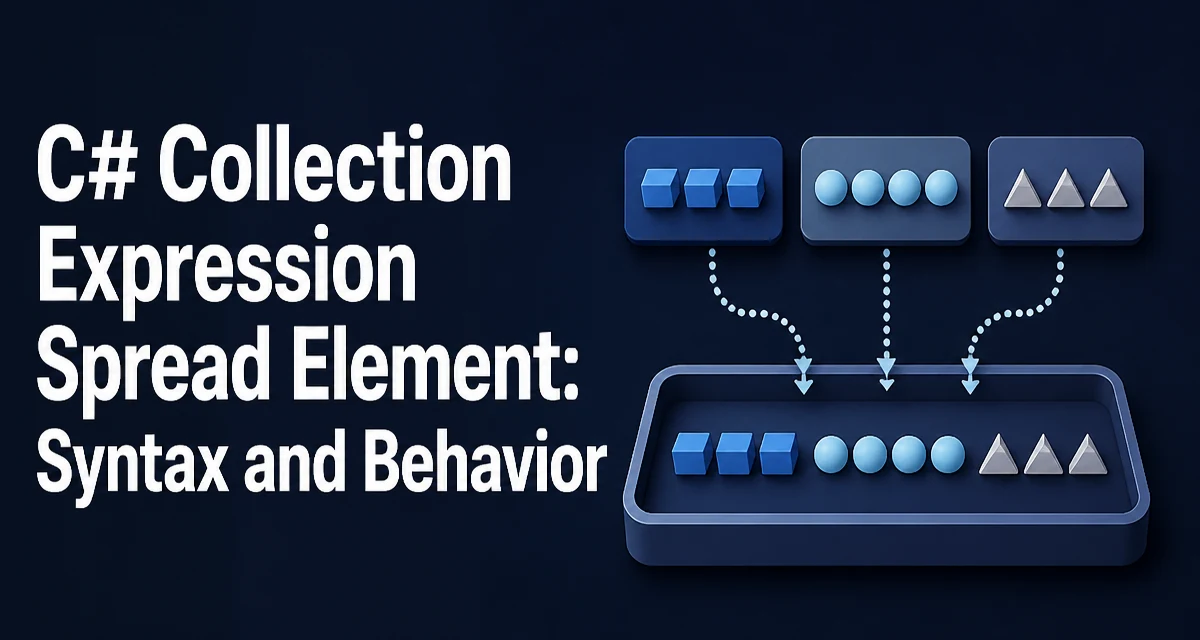
C# Collection Expression Spread Element: Syntax and Behavior
Use the `..` spread element in C# collection expressions to copy elements from an existing collection into arrays, lists, spans, and immutable arrays. Includes syntax, runtime behavior, allocation tradeoffs, and edge cases.
C# Span Usage: Process Memory Slices Without Allocations
c# span usage: Learn how to use Span<T> in C# to slice arrays and strings, avoid allocations, and process memory efficiently in high-performance code.
C# IComparable vs IComparer: When to Use Each
Understand the difference between IComparable and IComparer in C#, see how to implement both interfaces, and learn when each one fits sorting and comparison logic.
Implementing IComparable in C# for Reliable Sorting
c# icomparable: Learn how to implement IComparable<T> in C# for custom sorting, including CompareTo semantics, null handling, and consistency with Equals.
C# Comparable: Implementing IComparable for Sorting
Learn how to implement IComparable<T> in C# to sort custom objects with List.Sort and Array.Sort, including null handling and common edge cases.
C# Record Equality vs Class Equality Explained
C# records and classes differ in equality behavior. Learn how value semantics work, when reference equality still matters, and how to customize record equality.