Browse by Topic
Popular
Popular Posts



Latest
Latest C# Posts
C# List Initialization: Syntax, Examples, and Performance
c# list initialization: Learn C# list initialization with collection initializers, LINQ, and performance considerations for efficient code in your applications.

C# List Declaration: Syntax and Initialization
Learn how to declare and initialize List<T> in C#, including empty lists, collection initializers, initial capacity, var inference, and common declaration mistakes.
C# List Usage: Practical Guide to List<T> Operations
c# list usage: Learn how to use List<T> in C#: creation, adding, removing, iterating, sorting, and performance considerations for real-world code.
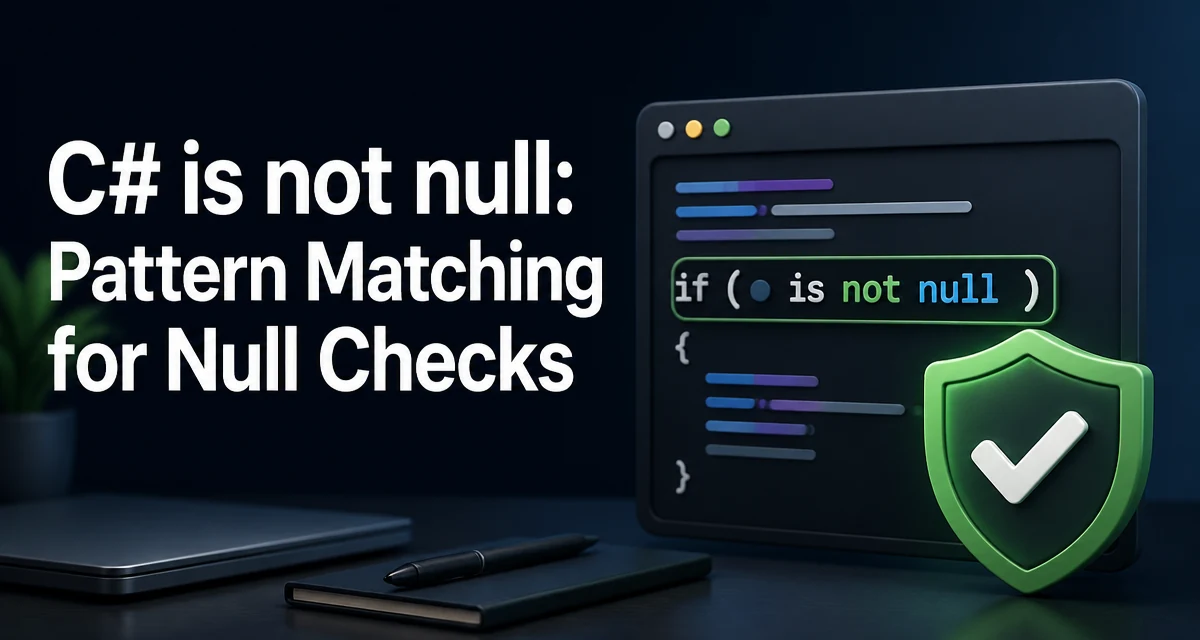
C# is not null: Pattern Matching for Null Checks
The C# is not null pattern is a concise, type-safe way to check for null values and avoids overloaded operator behavior. This article shows how it differs from != null and when to use it.
C# is null: Pattern Matching for Null Checks
c# is null: Learn how to use the `is null` pattern in C# for clear, reliable null checks, and see how it compares to other null-checking approaches.
C# Null Pattern Matching: Syntax and Practical Usage
Learn how C# null pattern matching can simplify null checks, combine with property patterns, and make conditional logic cleaner.

C# Null Forgiving Operator: Usage and Pitfalls
c# null forgiving operator: Learn how the C# null forgiving operator suppresses nullable warnings, when to use it, and common mistakes to avoid.
C# Null Check: Syntax, Patterns, and Pitfalls
Learn how to check for null in C# using equality operators, pattern matching, nullable types, and null-conditional operators. Avoid common pitfalls with practical examples.
C# Nullable Value Property: Syntax and Usage
Learn how to declare nullable value properties in C#, check for values with HasValue and pattern matching, and handle missing values safely with ??, GetValueOrDefault, and null assignment.

C# Nullable GetValueOrDefault: Usage and Behavior
Understand C# Nullable<T>.GetValueOrDefault: its overloads, behavior with HasValue, comparison with ??, and usage in LINQ and production code.