Kubernetes Services: ClusterIP, NodePort, LoadBalancer, and Headless DNS
A Service is a label query plus a packet rewrite. Endpoints only exist for ready pods, targetPort has to match a real listener, and externalTrafficPolicy decides whether you see the client's IP.
Quick Summary
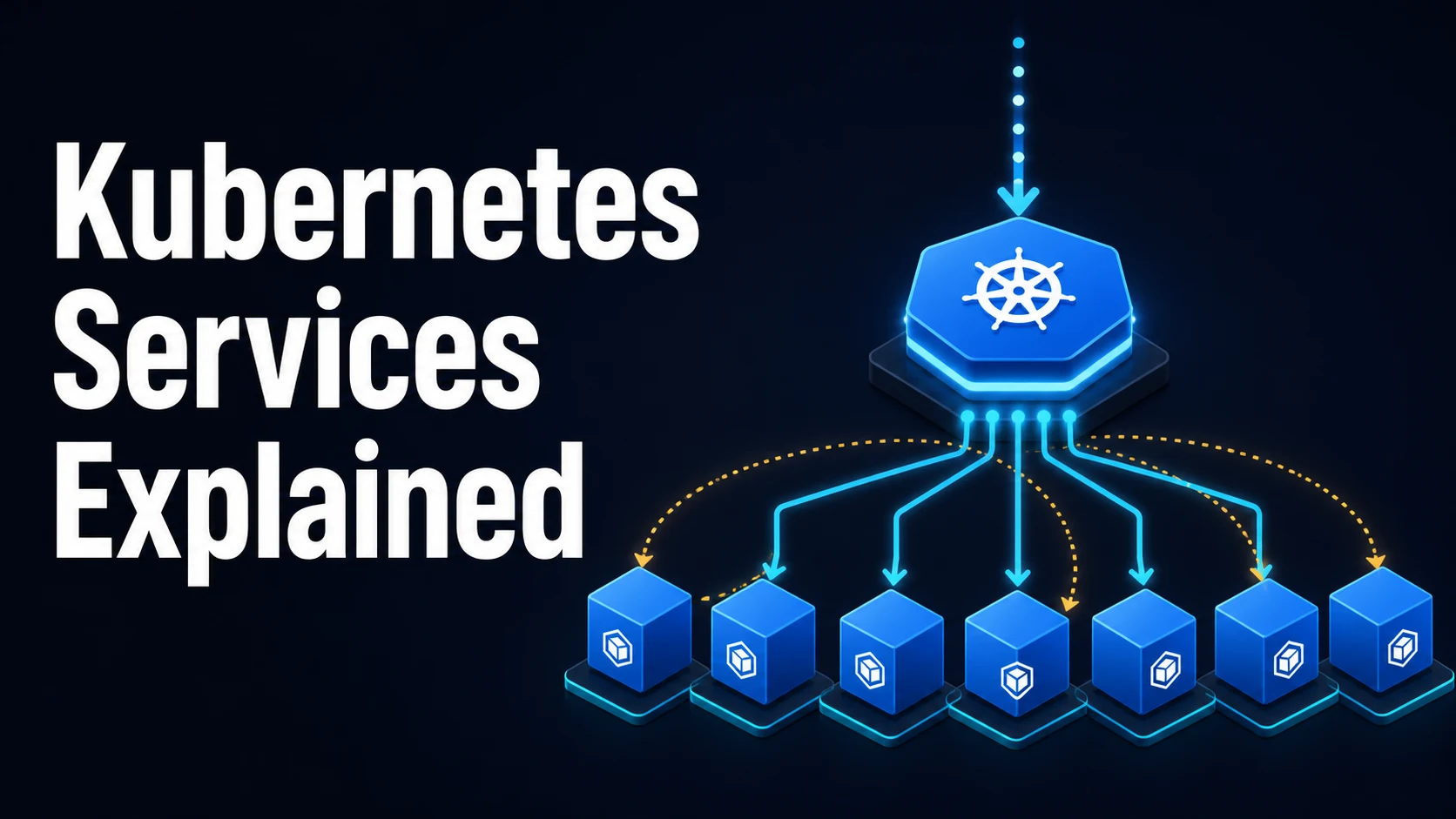
A Service is a stable virtual IP plus a DNS name in front of a set of pods chosen by labels. ClusterIP is the default and is reachable only inside the cluster: kube-proxy programs iptables/IPVS rules that rewrite packets destined for the virtual IP to a backing pod. NodePort additionally opens the same port on every node. LoadBalancer asks the cloud provider (or MetalLB) for an external IP and routes it to the NodePort. ExternalName is not proxying at all — it is a CNAME returned by DNS.
The endpoints behind a Service are not the pods matched by the selector; they are the ready pods matched by the selector, materialized in EndpointSlice objects. That single fact explains most Service failures: a selector that matches nothing gives a Service with no endpoints (connection refused), a pod failing its readiness probe is removed from the endpoints (traffic skips it), and a pod without a readiness probe is assumed ready as soon as the container runs.
A headless Service (clusterIP: None) does no proxying at all: DNS returns the pod IPs directly, which is how StatefulSets give each pod a stable name (pod-0.svc.namespace.svc.cluster.local) and how clients that need per-pod connections discover them. This guide covers the four types, port mapping (port versus targetPort versus nodePort), endpoint mechanics, traffic policy, DNS naming, and the debugging sequence that finds why a connection is refused.
Basic Syntax & Core Signatures
apiVersion: v1
kind: Service
metadata:
  name: api
  namespace: default
spec:
  type: ClusterIP          # ClusterIP | NodePort | LoadBalancer | ExternalName
  selector:
    app: api
  ports:
    - name: http           # required when there is more than one port
      port: 80             # the Service's port
      targetPort: 8080     # the container's port (number or named port)
      protocol: TCP
    - name: metrics
      port: 9090
targetPort: metricsapiVersion: v1
kind: Service
metadata:
name: api-node
spec:
type: NodePort
selector: { app: api }
ports:
- port: 80
targetPort: 8080
nodePort: 30080 # optional; otherwise an unused port in 30000-32767apiVersion: v1
kind: Service
metadata:
name: api-lb
annotations:
service.beta.kubernetes.io/aws-load-balancer-type: nlb # provider-specific
spec:
type: LoadBalancer
externalTrafficPolicy: Local # preserve client IP; only nodes with a pod answer
selector: { app: api }
ports:
- port: 443
targetPort: 8443apiVersion: v1
kind: Service
metadata:
name: db
spec:
clusterIP: None # headless
publishNotReadyAddresses: true # include pods that are not ready yet
selector: { app: db }
ports:
- port: 5432
targetPort: 5432kubectl get svc,endpointslice -o wide
kubectl get endpointslice -l kubernetes.io/service-name=api -o yaml
kubectl describe svc api
kubectl run net --rm -it --image=nicolaka/netshoot -- bash
# getent hosts api.default.svc.cluster.local
# curl -sv http://api:80/readyz
# dig +short api.default.svc.cluster.local
kubectl port-forward svc/api 8080:80Key Comparison Table
| Type | Reachable from | What it creates | Typical use |
|---|---|---|---|
ClusterIP | Inside the cluster | Virtual IP + DNS | Internal service-to-service |
NodePort | Any node IP, port 30000-32767 | ClusterIP + port on every node | Bare-metal, quick external access |
LoadBalancer | External IP from the provider | NodePort + provider LB | Public ingress |
ExternalName | Inside the cluster | CNAME record, no proxy | Point at an external hostname |
Headless (clusterIP: None) | Inside the cluster | Pod IPs in DNS, no VIP | StatefulSets, per-pod clients |
| Field | Meaning | Default |
|---|---|---|
port | Port the Service listens on | Required |
targetPort | Container port traffic is sent to | Same as port |
nodePort | Port exposed on each node | Allocated from 30000-32767 |
protocol | TCP, UDP, SCTP | TCP |
sessionAffinity | None or ClientIP | None |
externalTrafficPolicy | Cluster or Local | Cluster |
internalTrafficPolicy | Cluster or Local | Cluster |
publishNotReadyAddresses | Include not-ready pods in DNS/endpoints | false |
| Symptom | Meaning |
|---|---|
Connection refused immediately | Service has zero endpoints (selector mismatch, no ready pods) |
Connection timed out | A policy/firewall blocked it, or kube-proxy is not programming the VIP |
| DNS resolves, connection refused | Endpoints question, not DNS |
| DNS does not resolve | Wrong namespace/name, or CoreDNS problem |
| Works via port-forward, not via Service | targetPort or selector problem |
| Works inside the cluster, not outside | ClusterIP is not routable from outside |
503 from an ingress, 200 from pod IP | Endpoints empty or readiness failing |
Practical Edge Cases & Deep Dives
1. A Service with no endpoints: the selector is the suspect
$ kubectl get endpointslices -l kubernetes.io/service-name=api
NAME        ADDRESSTYPE   PORTS   ENDPOINTS   AGE
api-abc12   IPv4          8080    <unset>     14m

$ kubectl get svc api -o jsonpath='{.spec.selector}'
{"app":"api"}
$ kubectl get pods -l app=api --show-labels
NAME   READY   STATUS    LABELS
api-1  0/1     Running   app=api,tier=web     # not ready
An EndpointSlice with <unset> endpoints and a Service that matches pods means the pods are not ready — readiness probe failing, Ready=False, or terminating. kubectl get pods -l with the Service's selector reproduces exactly what the endpoints controller sees. A selector that matches nothing (a typo, or labels on the Deployment's template not on the pods) produces the same empty slice, and the failure is indistinguishable from outside: the connection is refused because there is nothing to rewrite the packet to.
kubectl get pods -l "$(kubectl get svc api -o jsonpath='{.spec.selector}' | tr -d '{}"' | tr ',' ',')" 2. port versus targetPort versus the pod's actual listener
ports:
  - port: 80            # clients connect to api:80
    targetPort: 8080    # and the packet is DNAT'd to pod-IP:8080
A common misconfiguration is a container that listens on 127.0.0.1:8080 instead of 0.0.0.0:8080. The pod's own IP is a different interface, so traffic forwarded to pod-IP:8080 is refused even though curl localhost:8080 inside the container works. The other is a named targetPort that does not match any containerPort name, in which case the EndpointSlice has the wrong port or none.
kubectl exec deploy/api -- ss -tlnp     # confirms 0.0.0.0 vs 127.0.0.1
kubectl get endpointslice -l kubernetes.io/service-name=api -o jsonpath='{.items[*].ports}'
3. NodePort, LoadBalancer, and where the client IP goes
$ curl -s https://api.example.com/whoami
{"remote":"10.244.3.7"}          # externalTrafficPolicy: Cluster — the node's IP
$ kubectl patch svc api-lb -p '{"spec":{"externalTrafficPolicy":"Local"}}'
$ curl -s https://api.example.com/whoami
{"remote":"203.0.113.42"}        # the real client IP
With Cluster (the default), a request that lands on a node without a local pod is forwarded again, and the source address becomes the node's, which breaks IP allowlists and rate limiting. With Local, kube-proxy only routes to local pods, so client IP survives — but nodes without a pod fail health checks and get removed from the load balancer, which is the correct behaviour and also the reason to run enough replicas or a DaemonSet. NodePort on a cloud load balancer exposes the node port publicly unless a firewall or security group blocks it, which is a frequent accidental exposure.
4. Headless services, StatefulSets, and DNS records
$ kubectl run net --rm -it --image=nicolaka/netshoot -- dig +short db.default.svc.cluster.local
10.244.1.5
10.244.2.8
10.244.3.2
$ dig +short -x 10.244.2.8
db-1.db.default.svc.cluster.local.
$ dig +short SRV _5432._tcp.db.default.svc.cluster.local
0 33 5432 db-1.db.default.svc.cluster.local.
A headless Service returns one A record per ready pod, and for a StatefulSet each pod gets a stable hostname pod-N.service.namespace.svc.cluster.local that survives rescheduling. publishNotReadyAddresses: true is required for peer discovery at bootstrap, when pods are intentionally not ready yet — without it, a cluster that needs to talk to itself to become ready deadlocks. Headless DNS returns all addresses and clients choose; there is no load balancing, no sessionAffinity, and no virtual IP to debug.
5. DNS search paths and the name that resolves to the wrong namespace
$ cat /etc/resolv.conf
search default.svc.cluster.local svc.cluster.local cluster.local
options ndots:5

$ getent hosts api          # api.default.svc.cluster.local if in default
$ getent hosts api.prod     # api.prod.svc.cluster.local — the namespace part matters
A bare api resolves within the client's own namespace first. Calling a Service in another namespace needs api.prod or the FQDN api.prod.svc.cluster.local, and a name that exists in both namespaces silently resolves to the wrong one. ndots:5 means any name with fewer than five dots is tried against every search suffix before the absolute name, which makes external hostnames slower to resolve and, in rare cases, resolves an internal name you did not intend.
6. kube-proxy modes and the "works on two of three pods" pattern
kubectl -n kube-system get pods -l k8s-app=kube-proxy -o wide
kubectl -n kube-system logs ds/kube-proxy --tail=50 | grep -i -E 'error|sync'
kubectl get svc api -o jsonpath='{.spec.clusterIP}{"\n"}'
In iptables mode, each connection is DNAT'd to a randomly chosen endpoint at connect time; long-lived connections therefore stick to one pod, and a pod that dies mid-connection produces resets until the client reconnects. In IPVS mode, conntrack and schedulers (rr, lc, sh) behave differently and the ipvsadm -Ln output on a node is authoritative. Neither mode retries a broken connection, so "one third of requests fail" usually means one endpoint in three is unhealthy but still in the endpoints list — which points back to the readiness probe.
Common Runtime & Configuration Mistakes
| Symptom | Cause | Fix |
|---|---|---|
| Connection refused | Service has no endpoints | Check selector and pod readiness |
Works via port-forward, not via Service | targetPort mismatch | Align targetPort with the actual listener |
curl localhost works in the pod, Service fails | App bound to 127.0.0.1 | Bind 0.0.0.0 |
| Same Service name resolves across namespaces | Short name resolves to the client's namespace | Use svc.namespace or the FQDN |
| Client IP is a node address | externalTrafficPolicy: Cluster | Set Local and size replicas accordingly |
| Load balancer marks nodes unhealthy | Local with no pod on every node | More replicas or a DaemonSet |
| Multiple ports rejected | Ports not named | Add name: to every entry |
nodePort out of range | Outside 30000-32767 | Omit it and let the allocator choose |
| Endpoints include a terminating pod | Readiness still true during termination | Add a preStop drain; readiness should fail fast |
| StatefulSet peers never connect at boot | Headless without publishNotReadyAddresses | Set it true for that Service |
ExternalName fails from outside the cluster | No DNS record is created, only a CNAME | Resolve it inside, or use a real Service |
Changing clusterIP is rejected | Immutable field | Delete and recreate the Service |
Services are a label query plus a packet rewrite, and every failure comes back to one of those two halves: does the selector match ready pods, and does the port arithmetic land on something that is actually listening on the pod's IP? Checking endpointslice first answers the first question, and ss -tlnp inside the container answers the second, before any network theory is needed.
Try matching browser tools
All toolsSmall utilities that fit Kubernetes work — they run entirely in this browser tab, so nothing you paste leaves your device.
Related Kubernetes guides
All Kubernetes guideskubectl Output: jsonpath, custom-columns, and the Debugging Commands Worth Knowing
jsonpath for one value in a script, custom-columns for tables people read, and kubectl debug when the container has no shell. Includes the three quoting layers that break jsonpath.
Kubernetes Namespaces, ResourceQuotas, and LimitRanges
A namespace is only a boundary when quota and limit range make it one. Aggregate caps, per-pod defaults, the admission errors they produce, and namespaces stuck Terminating.
Kubernetes StatefulSets: Ordinal Identities, Headless Services, and PVC Lifecycle
Why each StatefulSet pod keeps a name, a DNS record, and its own PVC; how OrderedReady gates startup on readiness; and how partition-based updates canary a single quorum member.
Kubernetes securityContext, Capabilities, and Pod Security Standards
The five fields that remove most container escapes, which of them only exist at container level, and how the restricted profile enforces the same settings at admission.
More in Kubernetes
All Kubernetes guidesThe guides filed next to this one in Kubernetes, in library order.