All syntax guides
Short, practical guides on programming syntax, language fundamentals, and the tools developers reach for every day.
3,965 guides across 14 topics
Topics
Popular guides
Most read



Latest guides
Page 394 of 397
C# String to Int Conversion: Parse vs TryParse vs Convert
Learn the practical differences between int.Parse, int.TryParse, and Convert.ToInt32 for C# string to int conversion, including error handling, null behavior, and culture.

C# Int to String Conversion: Methods and Pitfalls
Understand C# int-to-string conversion: ToString, Convert.ToString, string interpolation, culture-aware formatting, and common pitfalls to avoid.
C# Casting: Safe and Explicit Type Conversion
Learn how C# casting works: explicit casts, the as and is operators, boxing/unboxing, and common pitfalls with practical examples.
C# Explicit Conversion: Syntax and Use Cases
Learn how C# explicit conversion works, when to use casts, and how to avoid common pitfalls with user-defined and built-in conversions.

C# Implicit Conversion: How It Works and When to Use It
c# implicit conversion: Learn how C# implicit conversions work, how to define custom implicit operators, and when to avoid them to prevent data loss and bugs.
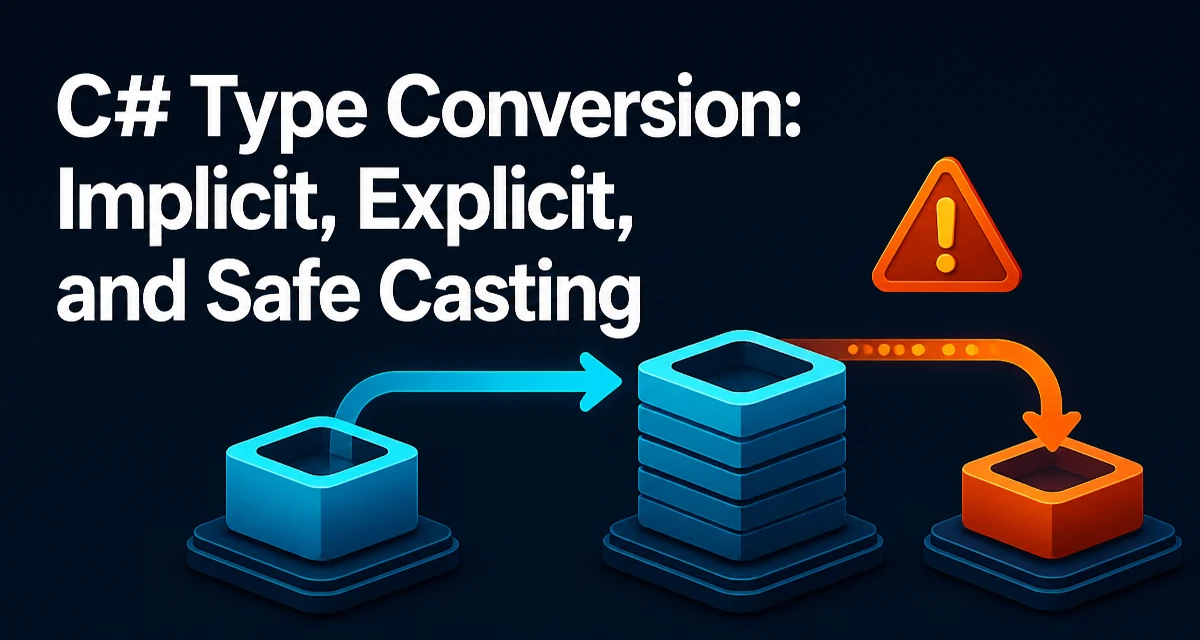
C# Type Conversion: Implicit, Explicit, and Safe Casting
Understand C# type conversion: implicit vs explicit casts, Convert and Parse methods, TryParse for safe user input, and the as operator for reference types.
C# Non-Nullable Reference Type Syntax
Learn the C# non-nullable reference type syntax: enable the nullable context, use the ? and ! operators, and handle compiler warnings in new and legacy code.
Understanding C# Nullable Reference Type Syntax
Learn how to use C# nullable reference type syntax, including enabling nullable annotations, declaring nullable and non-nullable references, using the null-forgiving operator, and handling compiler warnings during migration.
C# Nullable Enable Usage: Syntax and Patterns
c# nullable enable usage: Learn how to enable and use C# nullable reference types, interpret compiler warnings, and apply practical patterns for safer code.

Using C# Nullable Reference Types in Real Code
c# nullable reference type usage: Learn how to use C# nullable reference types: enabling the context, annotating with ?, handling warnings, and applying null-analysis...