TypeScript Mapped Types: Syntax, Key Remapping with as, and Modifiers
How mapped types iterate over keys, add and remove readonly and optional modifiers, and use the as clause to rename keys or drop properties entirely with never.
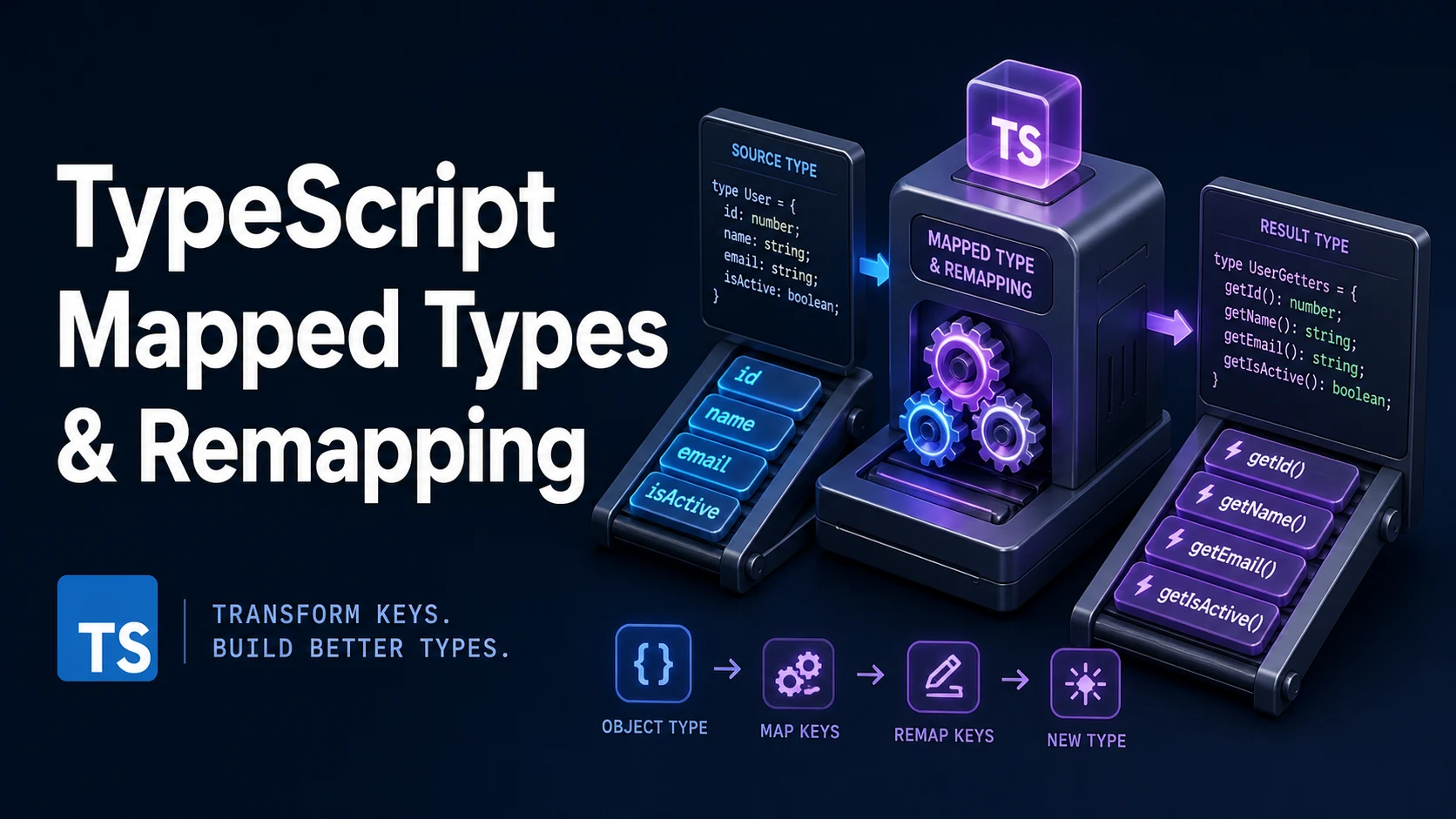
A mapped type is a type-level loop: it iterates over the keys of a source type, applies a rule to each property, and produces a new object type. Partial, Required, Readonly, Pick, Omit, and Record are all mapped types, and the as clause that arrived in TypeScript 4.1 turns the same construct into a key transformer — the mechanism behind string-prefixed accessors, event-name maps, and getter interfaces generated from data shapes.
Quick Summary
- The basic form is
{ [K in keyof T]: F<T[K]> }; homomorphic mapped types (those written[K in keyof T]) preserve modifiers and modifiers can be added or removed with+and-. readonlyand?modifiers are controlled per iteration:readonly [K in keyof T],-readonly [K in keyof T],[K in keyof T]-?.- Key remapping (
as) rewrites the key; returningneverfrom it drops the property entirely, which is how filtering mapped types are written. - The remapped key can be any type assignable to
PropertyKey, including a template literal type built from the original key and a string. - Arrays and tuples are object types with numeric-like keys, so a mapped type maps their elements — and tuples need special care because a naive mapping turns them into arrays.
- Homomorphic mapped types distribute over unions and preserve property modifiers; a non-homomorphic mapped type (
[K in SomeUnion]) creates a fresh object type and drops modifiers. - Filtering with
ascombined withkeyofis the documented way to emulateOmitwhile keeping the exact key set.
Basic syntax and type signatures
type Mutable<T> = { -readonly [K in keyof T]: T[K] };
type DeepPartial<T> = { [K in keyof T]?: T[K] extends object ? DeepPartial<T[K]> : T[K] };

// Key remapping with as.
type Getters<T> = {
  [K in keyof T as `get${Capitalize<string & K>}`]: () => T[K];
};

interface State { count: number; label: string }
type StateGetters = Getters<State>;
// { getCount: () => number; getLabel: () => string }

// Filtering: return never to drop a key.
type OnlyStrings<T> = {
  [K in keyof T as T[K] extends string ? K : never]: T[K];
};
type S = OnlyStrings<{ a: string; b: number; c: "x" }>;   // { a: string; c: "x" }

// Modifier removal.
type RequiredAndMutable<T> = { -readonly [K in keyof T]-?: T[K] };
string & K in the template literal is required because keyof T may include symbol or number keys, and only string keys can be interpolated into a template literal type. Without the intersection, Capitalize<K> rejects the whole mapping.
Comparison of mapped type forms
| Form | Homomorphic | Preserves optional/readonly | Distributes over unions | Typical use |
|---|---|---|---|---|
{ [K in keyof T]: T[K] } | yes | yes | yes | identity, modifier edits |
{ [K in keyof T]?: T[K] } | yes | adds optional | yes | partial updates |
{ -readonly [K in keyof T]: T[K] } | yes | removes readonly | yes | mutable copies |
{ [K in Union]: V } | no | no | no | dictionaries from a union |
{ [K in keyof T as X]: T[K] } | yes | yes | yes | renamed keys |
{ [K in keyof T as never]: T[K] } | yes | yes | yes | empty object type |
Record<K, V> (built-in) | no | no | no | explicit key sets |
The homomorphic row is the one that matters for surprises: { [K in keyof T]: ... } keeps ? and readonly unless the mapping writes them differently, while Record<keyof T, T[K]> drops both because it is not keyed by keyof T in the homomorphic position.
Practical edge cases and deep dives
1. Turning a config shape into a typed accessor interface
type Accessors<T> = {
  [K in keyof T & string as `get${Capitalize<K>}`]: () => T[K];
} & {
  [K in keyof T & string as `set${Capitalize<K>}`]: (value: T[K]) => void;
};

interface Settings {
  theme: "light" | "dark";
  fontSize: number;
}

const settings: Accessors<Settings> = {
  getTheme: () => "dark",
  setTheme: (v) => { /* ... */ },
  getFontSize: () => 14,
  setFontSize: (v) => { /* ... */ },
};

settings.setTheme("light");        // ok
// settings.setTheme("blue");      // error: not assignable to "light" | "dark"
// settings.setFontSize("14");     // error: string is not a number
The intersection of two mapped types is what makes this scale: getters and setters stay independent, each keeps the exact value type of the source property, and the implementation object is checked against the combined shape. Because the template literal is built from the key type, adding a property to Settings immediately requires two new methods on every implementation.
2. Filtering with as never and why Omit is not the same
type OmitByValue<T, V> = {
  [K in keyof T as T[K] extends V ? never : K]: T[K];
};

interface Form {
  id: number;
  name: string;
  createdAt: Date;
  updatedAt: Date;
  onSubmit: () => void;
}

type Serialized = OmitByValue<Form, Date | Function>;
// { id: number; name: string } — but the key type is what matters:

type Keys = keyof Serialized;     // "id" | "name"
Omit<T, K> renames around a key union, so it cannot express "drop the properties whose value is a Date". The as clause evaluates a type per key and uses never as the drop signal, which the compiler removes from the resulting key union. This is also the reason keyof after such a mapping is exact: Exclude-based Omit keeps the removed keys out of the type only through a second pass, while the as form never adds them.
3. Mapped types over tuples and arrays
type ArrayToTuple<T extends readonly unknown[]> = {
  [K in keyof T]: T[K];
};
// Homomorphic over a tuple keeps the tuple shape.
type A = ArrayToTuple<[string, number]>;         // [string, number]

// Mapping to a fixed value type turns a tuple into an array-like object.
type Flags<T extends readonly unknown[]> = { [K in keyof T]: boolean };
type B = Flags<["a", "b"]>;                      // [boolean, boolean]

// Indexing a mapped tuple with `number` gives the element union.
type Elem = Flags<["a", "b"]>[number];           // boolean

// Array types: `keyof string[]` includes length, methods, and number.
type Bare<T extends readonly unknown[]> = { [K in keyof T]: T[K] };
A homomorphic mapped type over readonly [A, B] stays a readonly tuple, which is why Promise.all returns a tuple of results rather than an array. Mapping over T[] yields another T[], and the method keys (push, map, length) map along with the elements but keep their original types because the mapping rule only changes the value type, not the key. Replacing the value type unconditionally on an array type breaks the methods, which is why library code constrains to readonly unknown[] and maps homomorphically.
4. Modifier surgery for update payloads
type Update<T, K extends keyof T> = Omit<T, K> & {
  [P in K]-?: T[P];
};

interface User { id: string; name: string; email?: string }

type CreatePayload = Update<User, "name" | "email">;
// { id: string; name: string; email: string }
// note: `email` is now required; `id` is still required from Omit

// The safer form for updates: make everything optional except the key.
type Patch<T, K extends keyof T> = Omit<T, K> &
  Partial<Pick<T, K>> & { [P in K]-?: T[P] };

type UserPatch = Patch<User, "id">;
// { id: string; name?: string; email?: string }
-? on a mapped type forces the property to be present, which is exactly what a "name may not be omitted but its value may be updated" rule needs. The union with Omit<T, K> is what carries the untouched properties through: a mapped type alone can only rewrite the keys in the source list.
5. Recursive mapped types for deep transforms
type DeepReadonly<T> = T extends (infer U)[]
  ? readonly DeepReadonly<U>[]
  : T extends object
    ? { readonly [K in keyof T]: DeepReadonly<T[K]> }
    : T;

type DeepMutable<T> = T extends readonly (infer U)[]
  ? DeepMutable<U>[]
  : T extends object
    ? { -readonly [K in keyof T]: DeepMutable<T[K]> }
    : T;

interface Tree {
  readonly name: string;
  readonly children: readonly Tree[];
}

type Frozen = DeepReadonly<Tree>;    // no assignment anywhere in the tree
type Thawed = DeepMutable<Tree>;     // every level assignable
The array branch must come first: object matches arrays too, and mapping their keys would rewrite length and the methods. readonly (infer U)[] handles both mutable and readonly input arrays, so one definition covers both. Deep recursive mapped types are the place where the compiler's instantiation depth limit matters most; constraining the input to concrete interfaces rather than open generics keeps the cost bounded.
Common mistakes and compiler errors
| Error or symptom | Cause | Fix |
|---|---|---|
Type 'K' cannot be used to index type 'T' | K in keyof T used without the mapping being homomorphic | write [K in keyof T]: ... on the source type itself |
Remapped key is never for all properties | the filter condition is inverted or the value type test is wrong | check T[K] extends V ? never : K and the literal types involved |
Type 'symbol' is not assignable to type 'string' in a template literal key | keyof T includes symbol or number | constrain with keyof T & string |
| Optional properties disappear after a mapping | the mapping was not homomorphic | iterate keyof T directly instead of Record<keyof T, ...> |
readonly lost on array elements | the mapping replaced the element type on an array | use a homomorphic map with a conditional branch for arrays |
Tuple maps to boolean[] instead of [boolean, boolean] | the mapped type is constrained to unknown[] and mapped as an array | keep the parameter as a tuple type and map homomorphically |
Type instantiation is excessively deep | unbounded recursion through a generic object | add a depth limit or a base case for primitives |
Object literal may only specify known properties on the mapped result | the remapped keys differ from what the literal used | check Capitalize/Uppercase output, and that as was applied to the right key |
Two habits prevent nearly all of these. First, always test the mapped type with a keyof assertion — type _ = Expect<Equal<keyof Result, "a" | "b">> — because a mapped type that produces the right properties with a wrong key union still compiles everywhere and fails only when used as a key. Second, when the mapping adds or removes modifiers, write the modifier explicitly (+readonly, -?) so the intent is visible in the type and not inferred from the source.
Try matching browser tools
All toolsSmall utilities that fit TypeScript work — they run entirely in this browser tab, so nothing you paste leaves your device.
Related TypeScript guides
All TypeScript guidesTypeScript Generic Parameter Defaults: Syntax, Precedence, and Inference
When a default applies and when inference wins, defaults that reference earlier parameters, and how a defaulted type parameter keeps a library change non-breaking.
TypeScript Branded Types: Nominal Typing, Type Tags, and Validation
How a phantom property makes two strings incompatible, unique symbol brands, unit-typed numbers, and the places where a brand quietly disappears.
TypeScript Ambient Declarations: .d.ts Files, declare, and declare global
How declare and .d.ts files describe runtime values, wildcard modules for assets, declare global with var, and module augmentation of third-party types.
TypeScript Discriminated Unions: Exhaustiveness Checking and the never Type
Why the discriminant must be a literal, how never closes an exhaustive switch, and the duplicate-discriminant bug that lets a missing case compile.
More in TypeScript
All TypeScript guidesThe guides filed next to this one in TypeScript, in library order.