TypeScript Type Assertions: as Syntax, Non-Null Assertion, and Safety
What an assertion actually promises, when the compiler rejects one, how as unknown as T bypasses the check, and where ! hides a lifecycle bug.
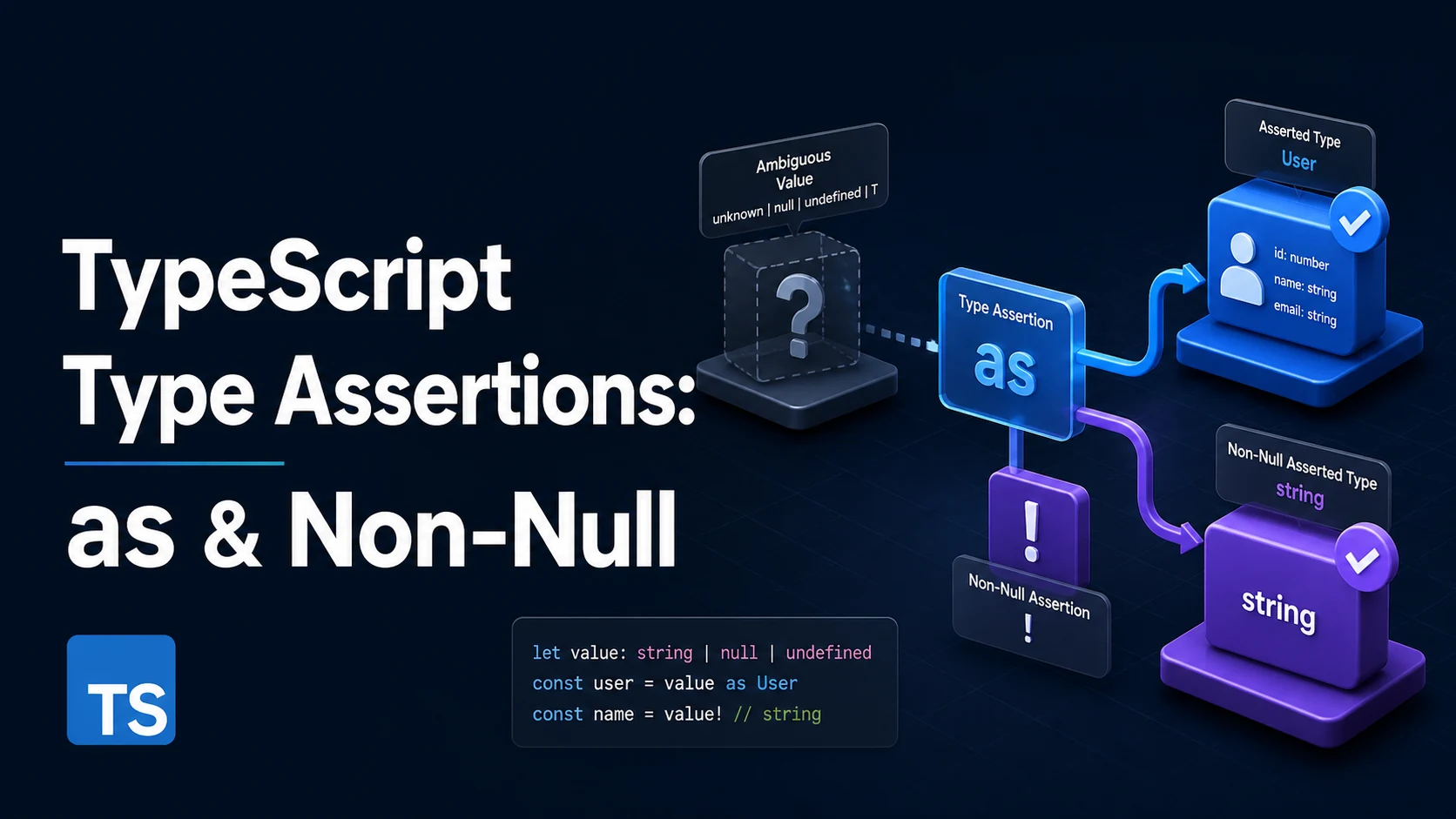
A type assertion tells the compiler to treat an expression as a different type. It is erased at compile time, it performs no conversion, and it cannot be verified: value as string on a number produces code that still holds a number, and the first method call on it throws. The compiler's only guard is comparability — an assertion is rejected when neither type is assignable to the other — and that guard is what as unknown as T exists to bypass.
Quick Summary
value as Tand<T>valueare the same assertion; the angle-bracket form is illegal in.tsxfiles, where it parses as JSX.- An assertion compiles only when
Tis assignable to the expression's type or the expression's type is assignable toT; otherwiseTS2352. as unknown as T(oras any as T) is the escape hatch for genuinely unrelated types, and it also discards any error the compiler would have caught.- The non-null assertion
!asserts that a value is neithernullnorundefined; it is erased and does not check anything at runtime. !also appears in definite assignment (let el!: HTMLElement), which is a different assertion about initialization, not about nullability.as constis a const assertion, not a type cast: it changes inference to literal and readonly types rather than naming a type.satisfies Tvalidates an expression againstTwhile keeping its inferred, narrower type — the checkas Tskips.- Every assertion the compiler accepts is a promise the program must keep; the only assertions worth keeping in application code are those next to a runtime check that keeps the promise.
Basic syntax and type signatures
const el = document.querySelector("#app") as HTMLDivElement;
const el2 = <HTMLDivElement>document.querySelector("#app");   // not valid in .tsx

const raw = JSON.parse(text) as Config;        // no validation happened
const id = event.target as HTMLElement;

let maybe: string | null = "x";
const definite: string = maybe!;               // null stripped, no check
The two permitted shapes of a legal assertion:
declare const narrow: "a" | "b";
const wide = narrow as string;        // ok: "a" | "b" is assignable to string
const back = wide as "a" | "b";       // ok: string is not assignable to it, but it is assignable from it

declare const num: number;
// const bad = num as string;         // TS2352: neither type sufficiently overlaps
const forced = num as unknown as string;   // compiles; still a number at runtime
TS2352 reads: "Conversion of type 'number' to type 'string' may be a mistake because neither type sufficiently overlaps with the other. If this was intentional, convert the expression to 'unknown' first." That message is the compiler admitting the limit of its structural check — it compares assignability in both directions, and when both fail it asks for an explicit two-step.
Comparison of assertion-like operators
| Form | Effect on the type | Runtime effect | Keeps inferred type | Typical use |
|---|---|---|---|---|
value as T | claims T | none | no | DOM queries, library boundaries |
<T>value | same as as T | none | no | .ts only |
value as unknown as T | claims T through unknown | none | no | unrelated types, migrating |
value! | removes null and undefined | none | yes, minus null | values proven non-null elsewhere |
let x!: T | definite assignment | none | yes | class fields set in a lifecycle method |
value as const | literal and readonly | none | yes, narrowed | config objects, tuple literals |
value satisfies T | keeps inferred type, checked against T | none | yes | validating while inferring |
The last two are the ones that improve safety; the first four are the ones that remove it, in proportion to how far the claimed type is from what the expression actually is.
Practical edge cases and deep dives
1. Assertions at the JSON boundary are unchecked
interface Config { port: number; host: string }

// The common, wrong version.
const config = JSON.parse(process.env.CONFIG ?? "{}") as Config;
config.port.toFixed(0);          // throws if the JSON had "8080" as a string

// The version that keeps the assertion honest.
function parseConfig(input: string): Config {
  const raw: unknown = JSON.parse(input);
  if (typeof raw !== "object" || raw === null) throw new Error("config is not an object");
  const { port, host } = raw as { port?: unknown; host?: unknown };
  if (typeof port !== "number" || !Number.isFinite(port)) throw new Error("port must be a number");
  if (typeof host !== "string" || host.length === 0) throw new Error("host must be a string");
  return { port, host };          // constructed, not cast
}
The as in the second version narrows an unknown far enough to read two properties; every property is then checked, and the returned object is built from the checked values. That is the pattern that makes assertions defensible: the cast touches unknown (where nothing is known anyway), and the function's return type is established by construction rather than by claim. JSON.parse is typed any, which is worse than unknown — asserting on any produces no TS2352 even for impossible conversions.
2. Double assertions: unknown versus any
const sym = Symbol("s");
const asString = sym as unknown as string;   // compiles
const asString2 = sym as any as string;      // compiles, and is `any` along the way

// Where a double assertion is legitimate: adding a brand or a phantom field.
type UserId = string & { readonly __brand: "UserId" };
function toUserId(raw: string): UserId {
  if (!/^[0-9a-f]{24}$/.test(raw)) throw new Error("invalid id");
  return raw as UserId;                       // one hop: string is assignable to the intersection
}
as any as T turns the expression into any at the intermediate step, and every later operation on that value is unchecked until it is assigned to a typed location — the any leaks through property access in ways unknown cannot. Prefer as unknown as T, and prefer neither when a constructor or a validator can produce a genuinely typed value. The most common honest double assertion is a phantom brand on a primitive that was already validated, which needs only one hop (raw as UserId) because string is assignable to string & {...}.
3. Non-null assertions hide the two bugs they usually accompany
function first(items: string[]): string {
  return items[0]!;                 // throws at runtime only if the caller passes []
}

function toggle(state: { open: boolean }, ref: { el: HTMLElement | null }) {
  state.open = !state.open;
  ref.el!.classList.toggle("open"); // throws on the first render
}

class Panel {
  private root!: HTMLElement;       // definite assignment; nothing checks it ran

  mount(parent: HTMLElement) {
    this.root = document.createElement("div");
    parent.append(this.root);
  }

  show() {
    this.root.hidden = false;       // throws if show() runs before mount()
  }
}
The array case is fixed by a real check (if (items.length === 0) throw ... or a return type of string | undefined), and the DOM case by optional chaining (ref.el?.classList.toggle("open")) or by making the ref non-null at construction. The class-field case is fixed by initializing in the constructor or by taking the element as a constructor argument — ! on a field silences TS2564: Property 'root' has no initializer and is not definitely assigned in the constructor, which is the compiler telling the truth about the lifecycle.
There is one place where ! is correct: a value whose non-nullness the compiler cannot see but whose invariant is guaranteed by an earlier check in the same function.
function normalize(map: Map<string, string[]>, key: string): string[] {
  let list = map.get(key);
  if (!list) {
    list = [];
    map.set(key, list);
  }
  return list;                       // no assertion needed: control flow proves it
}
No ! appears here because narrowing does the work. When the compiler cannot follow the proof — a closure, a getter, a second read of a mutable global — an assertion may be the only option, and it should be next to a comment saying which invariant makes it safe.
4. as const, as T, and satisfies are three different tools
const roles = ["admin", "editor"];                 // string[]
const rolesConst = ["admin", "editor"] as const;   // readonly ["admin", "editor"]

type Role = (typeof rolesConst)[number];           // "admin" | "editor"

interface Config { retries: number; url?: string }

const wrong = { retries: 3, urll: "x" } as Config;   // TS2352 or silent excess-property skip
const checked = { retries: 3, urll: "x" } satisfies Config;  // error: urll is not in Config
const good = { retries: 3, url: "/api" } satisfies Config;   // type is the literal object
const widened: Config = { retries: 3, url: "/api" };         // type is Config
satisfies keeps the narrow type, so good.retries is 3 rather than number, and a misspelled property is an error instead of an extra field that disappears at the assertion boundary. as Config on an object literal also suppresses the excess-property check, which is why an as on a config object so often hides a typo. The remaining legitimate use of as on literals is asserting a discriminant the compiler cannot infer, and even then satisfies on a helper function is usually clearer.
5. Asserting function types and the variance it hides
type Handler = (event: { type: string }) => void;

declare const specific: (event: { type: "click"; x: number }) => void;

// Direct assignment is rejected under strictFunctionTypes: parameter types are contravariant.
// const loose: Handler = specific;

const loose = specific as unknown as Handler;   // compiles, then crashes on a "keydown"
loose({ type: "keydown" });                     // specific reads event.x, which is undefined
Function-parameter variance is where an assertion does the most damage, because the wrong call signature is invisible until a caller uses the type the assertion invented. The safe direction is the opposite: a function that accepts a wider parameter is assignable to a type that accepts a narrower one, so widening the parameter (or using a generic) keeps the assignment checkable. The same hazard applies to asserting a class instance to a subclass (el as HTMLInputElement) and then reading a property that the actual element does not have.
Common mistakes and compiler errors
| Error or symptom | Cause | Fix |
|---|---|---|
TS2352: Conversion of type A to type B may be a mistake | neither type is assignable to the other | assert through unknown only if truly intended, otherwise fix the types |
TS17002: Expected corresponding JSX closing tag | angle-bracket assertion in .tsx | use as T |
TS1005: '>' expected in .tsx or with generics | <T>expr parsed as JSX or as a comparison | use as T |
Runtime Cannot read properties of null right after ! | the asserted invariant did not hold | replace with a check or optional chaining |
TS2564: Property has no initializer silenced by ! | definite assignment on a field never assigned | initialize it, or set it in the constructor |
Assertion has no effect on a const | widening already happened elsewhere | assert at the declaration, or use as const |
as T on an object literal ignores a typo | excess-property check skipped by the assertion | use satisfies T |
TS2352 when casting to a generic T | T is unconstrained | cast through unknown, or constrain T |
| A cast fixes the compile error and crashes later | the runtime value is not the claimed type | validate at the boundary and construct |
any spreads after as any as T | intermediate any unchecked | prefer as unknown as T |
The working rule is narrow: assert only where the expression's type is less precise than the truth, never where it is more precise. document.querySelector returns Element | null while the application knows the node is an input, so as HTMLInputElement adds information the compiler lacked — although a null check is still needed. JSON.parse returns any while the application hopes the payload is Config, so as Config invents information nobody verified. The first assertion is a statement about the DOM the code controls; the second is a wish, and every runtime crash traced back to a cast in application code is a wish that did not come true.
Try matching browser tools
All toolsSmall utilities that fit TypeScript work — they run entirely in this browser tab, so nothing you paste leaves your device.
Related TypeScript guides
All TypeScript guidesTypeScript Generic Parameter Defaults: Syntax, Precedence, and Inference
When a default applies and when inference wins, defaults that reference earlier parameters, and how a defaulted type parameter keeps a library change non-breaking.
TypeScript Branded Types: Nominal Typing, Type Tags, and Validation
How a phantom property makes two strings incompatible, unique symbol brands, unit-typed numbers, and the places where a brand quietly disappears.
TypeScript Ambient Declarations: .d.ts Files, declare, and declare global
How declare and .d.ts files describe runtime values, wildcard modules for assets, declare global with var, and module augmentation of third-party types.
TypeScript Discriminated Unions: Exhaustiveness Checking and the never Type
Why the discriminant must be a literal, how never closes an exhaustive switch, and the duplicate-discriminant bug that lets a missing case compile.
More in TypeScript
All TypeScript guidesThe guides filed next to this one in TypeScript, in library order.