Browse by Topic
Popular
Popular Posts

Latest
Latest Posts
C# Comparison Operators: Syntax and Behavior
Understand how C# comparison operators behave for numeric types, strings, nullable values, floating-point values, and custom types, including operator overloading and common pitfalls.
C# Prefix vs Postfix Increment
Understand how C#'s prefix (++i) and postfix (i++) increment operators differ, including evaluation order, return values, and practical examples.
C# Increment and Decrement Operators: Prefix vs Postfix
Understand how C# ++ and -- operators work in expressions and loops, and learn when prefix vs postfix behavior matters.
C# Checked vs Unchecked: Controlling Integer Overflow
Understand how C# checked and unchecked contexts control integer overflow, when to use each, and how they affect runtime behavior and performance.
C# Pattern Matching Type Conversion: Type Patterns
Use C# pattern matching type conversion with type patterns, switch expressions, and property patterns. Includes null handling, records, tuples, guards, and performance considerations.
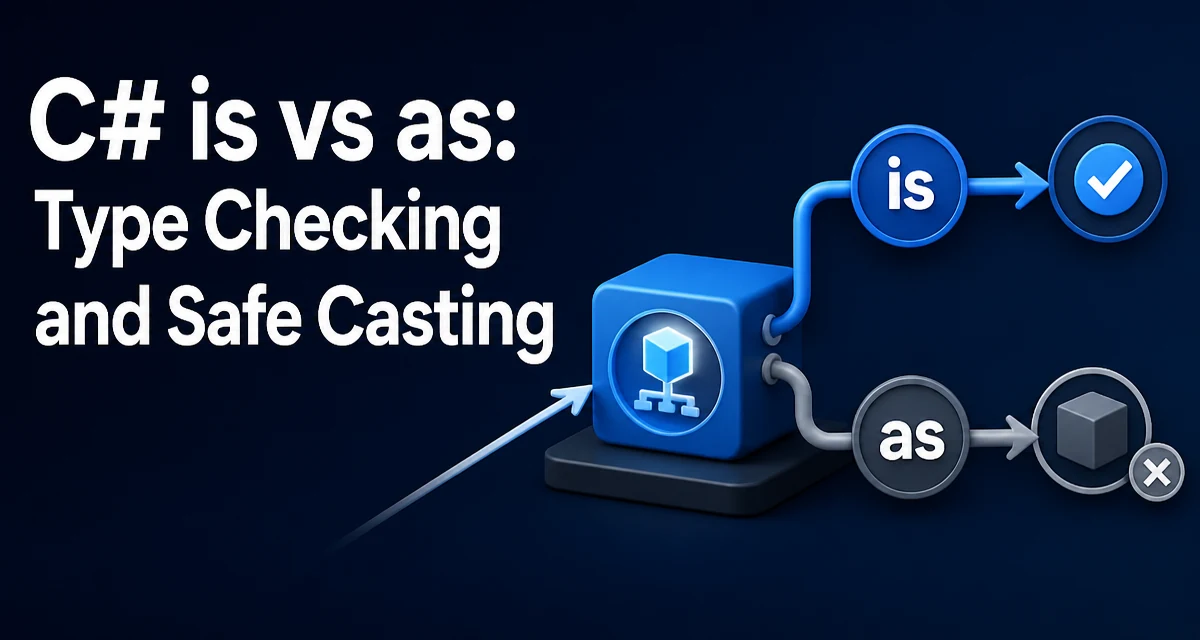
C# is vs as: Type Checking and Safe Casting
C# is vs as: Understand the differences between C#'s is and as operators for type checking and safe casting, including syntax, runtime behavior, and when to use each.
C# as Operator Usage: Syntax, Behavior, and Practical Examples
Learn how the C# `as` operator performs safe type conversion, when to prefer it over explicit casts, and why pattern matching is often a better choice in modern C#.
C# is Operator Usage: Type Checking and Pattern Matching
Learn how to use the C# is operator for type checking and pattern matching. This guide covers pattern forms, practical examples, and comparisons with as and explicit casts.
C# Convert vs Parse: When to Use Each
Compare C# Convert and Parse methods for type conversion, error handling, null behavior, and performance to choose the right approach.
C# Parse vs TryParse: When to Use Each
Compare C# Parse and TryParse for string-to-number conversion, covering exception behavior, performance, and when to use each.