Browse by Topic
Popular
Popular Posts

Latest
Latest Posts

PyTorch vs TensorFlow: Which One Fits Your Project
Compare PyTorch and TensorFlow from a developer's perspective: API design, training loops, debugging, deployment, and decision criteria for your project.

Python PyTorch GPU Memory Optimization
python pytorch gpu memory optimization: Learn practical techniques to reduce GPU memory usage in PyTorch: mixed precision, gradient accumulation, checkpointing, and pr...

PyTorch Mixed Precision Training with torch.cuda.amp
Use PyTorch's autocast and GradScaler for mixed precision training on CUDA GPUs: reduce memory use, accelerate Tensor Core GPUs, and avoid gradient underflow.
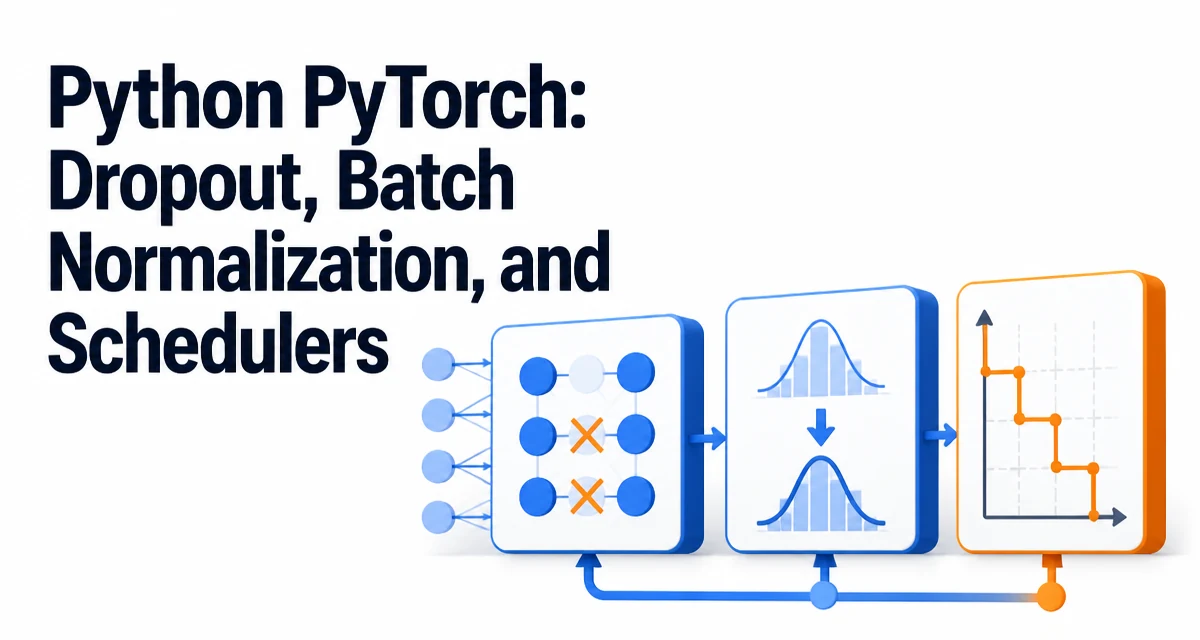
Combining Dropout, Batch Normalization, and Learning Rate Schedulers in PyTorch
Learn how to combine dropout, batch normalization, and learning rate schedulers in PyTorch, including layer placement, train/eval modes, scheduler timing, and common pitfalls.
PyTorch Inference: model.eval() vs torch.no_grad() vs torch.inference_mode()
Learn how model.eval(), torch.no_grad(), and torch.inference_mode() affect PyTorch inference, when to combine them, and which context to choose.
How to Save and Load PyTorch state_dict and Checkpoints
Learn how to save and load PyTorch models with state_dict and full checkpoints, including optimizer state, epoch, and safe device handling.
PyTorch Training and Validation Loops in Python
Learn how to structure PyTorch training and validation loops, handle device placement, manage gradients, and avoid common pitfalls.

PyTorch Dataset and DataLoader for Custom Datasets
Implement custom PyTorch datasets with __getitem__ and __len__, then use DataLoader for batching, shuffling, and parallel loading.
PyTorch Loss Functions and Optimizers: Adam vs SGD
python pytorch loss functions optimizers adam and sgd: How to pair loss functions with optimizers in PyTorch, and how Adam and SGD differ in update behavior, memory us...
PyTorch torch.nn Layers and Activation Functions: A Practical Guide
Build PyTorch neural networks with torch.nn layers and activation functions. Covers nn.Linear, nn.Conv2d, nn.Sequential, custom nn.Module models, initialization, and the functional API.