Docker Restart Policies: no, on-failure, always, and unless-stopped
What each policy really restarts, why on-failure ignores a clean exit, how backoff hides crash loops, and why health checks never trigger a restart.
Quick Summary
A Docker restart policy answers one question: when the container's main process exits, should the engine start it again, and under what condition. There are four values. no (the default) never restarts. on-failure[:max] restarts only on a non-zero exit code, optionally at most max times. always restarts on any exit and also brings the container back when the daemon starts. unless-stopped behaves like always but remembers a manual docker stop and stays down across daemon restarts.
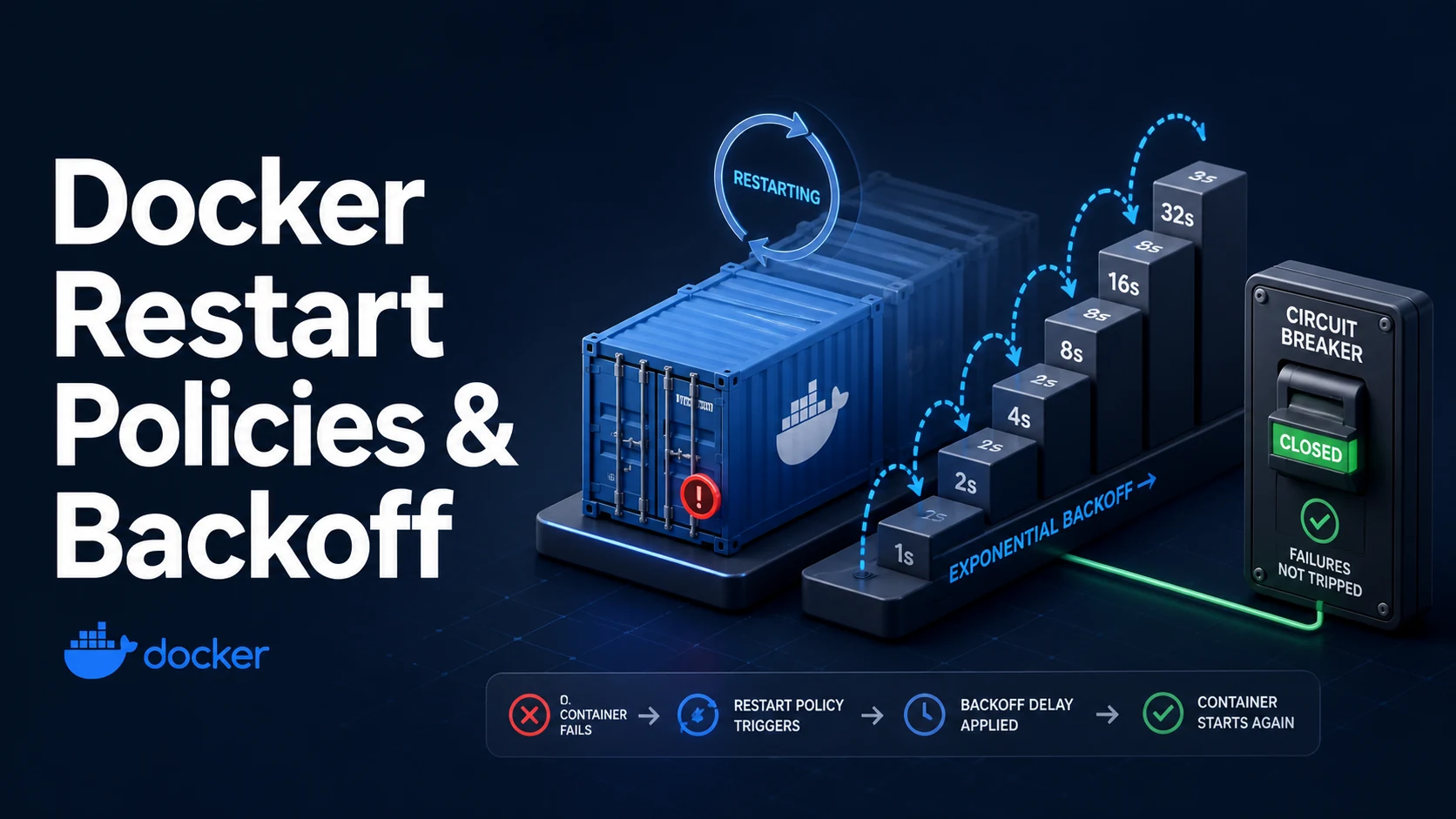
The policy does not cover what most people assume it covers. A health check failing does not restart a container under any of these policies — only the Swarm/orchestrator restart logic acts on health. A policy also cannot fix an application that fails during dependency startup: it will simply restart forever with the same result. Restarts use an exponential backoff (starting at roughly 100 ms, doubling, capped near one minute in current engine versions) that resets once the container has stayed up, so a permanently broken image produces a slow, quiet crash loop rather than a CPU spike.
Use unless-stopped for long-running services on a single host, on-failure:3 for one-shot jobs where a few retries are legitimate, and no for anything whose lifecycle an orchestrator owns. Then add a health check and monitoring for the states the policy cannot see — running-but-broken.
Basic syntax and query signatures
# Docker CLI
docker run -d --restart=unless-stopped --name api my/api:1.4
docker run --restart=on-failure:3 --name migrate my/api:1.4 migrate
docker run --restart=no my/api:1.4            # default

# Change it on a running container, no restart required
docker update --restart=always api

# Inspect what is actually configured
docker inspect -f '{{.HostConfig.RestartPolicy.Name}} {{.HostConfig.RestartPolicy.MaximumRetryCount}}' api
docker inspect -f '{{.RestartCount}} {{.State.Status}} {{.State.ExitCode}}' api
Compose v2 syntax, plus the Swarm form that lives under deploy.
services:
  api:
    image: my/api:1.4
    restart: unless-stopped            # maps to the same engine policy
  worker:
    image: my/worker:1.4
    restart: on-failure:5
  migrate:
    image: my/api:1.4
    command: ["/app/migrate"]
restart: "no" # quote it or YAML reads falsedeploy:
restart_policy:
condition: on-failure # none | on-failure | any
delay: 5s
max_attempts: 3
window: 60sThe daemon default can be set once for every container that does not specify its own policy:
{ "default-address-pools": [], "restart-policy": "unless-stopped" }Key comparison table
| Policy | Restart on exit 0 | Restart on non-zero | Restart after docker stop | Restart after daemon boot |
|---|---|---|---|---|
no | No | No | No | No |
on-failure | No | Yes | n/a | Yes, if it had failed |
on-failure:N | No | Yes, up to N | n/a | Yes, budget preserved |
always | Yes | Yes | Yes | Yes |
unless-stopped | Yes | Yes | No (stays stopped) | Yes, unless stopped |
| Concern | Restart policy | Health check | Orchestrator |
|---|---|---|---|
| Process exited | Acts | — | Acts |
| Process alive but unresponsive | Cannot see | Detects, does not restart | Restarts (Swarm/K8s) |
| Dependency not ready | Loops blindly | Waits, then reports unhealthy | Waits, then fails |
| Restart ordering between services | None | None | depends_on + health condition |
| Setting | Scope | Note |
|---|---|---|
--restart on docker run | One container | Ignored with --rm |
restart: in Compose | One service | Recreated on docker compose up |
deploy.restart_policy | Swarm service | Compose ignores it outside Swarm |
docker update --restart | Live container | Does not restart it immediately |
live-restore daemon option | Host | Keeps containers running across daemon reloads |
Practical edge cases and deep dives
1. on-failure and exit code 0: a silent no-restart
An application that exits cleanly when its database is unreachable — quite common for a main that logs an error and returns — will never be restarted by on-failure, because the process reported success.
docker run -d --restart=on-failure:3 my/api:1.4
sleep 5
docker inspect -f '{{.State.Status}} exit={{.State.ExitCode}} restarts={{.RestartCount}}' api
# exited exit=0 restarts=0
Make the process exit non-zero on unrecoverable startup failure, or accept that on-failure is the wrong policy for that service.
2. always versus unless-stopped after a daemon restart
docker run -d --restart=always --name a nginx:alpine
docker run -d --restart=unless-stopped --name b nginx:alpine
docker stop a b
sudo systemctl restart docker
docker ps --format '{{.Names}} {{.Status}}'
# a  Up ...      (always ignores the manual stop)
# b             (unless-stopped honours it)
This is the whole reason unless-stopped exists: maintenance stops survive a reboot. always is appropriate only for infrastructure you genuinely never want down, such as a monitoring agent.
3. Crash loops are quiet, and backoff hides them
The restart delay grows, so a container that fails immediately on start settles into a loop of "start, die, wait a minute". docker ps shows Restarting (1) 40 seconds ago, which reads like a transient problem.
docker ps --filter name=api --format '{{.Names}} {{.Status}}'
docker events --filter container=api --filter event=restart --since 10m
docker logs --tail 50 api          # logs survive restarts of the same container id
Alert on RestartCount increasing rather than on the container being absent, because a crash loop is always "present".
4. Restart policies do not order services
With Compose, after docker compose up, a restarted dependency does not bring its dependents back, and a dependent that starts first will fail and restart on its own schedule.
services:
  db:
    image: postgres:16
    healthcheck:
      test: ["CMD-SHELL", "pg_isready -U postgres"]
      interval: 5s
      retries: 12
  api:
    depends_on:
      db:
        condition: service_healthy
    restart: unless-stopped
    environment:
      DB_HOST: db
depends_on with service_healthy only affects initial startup order. After a db restart, api keeps running against a broken connection. Application-level retry with backoff — reconnect loops inside the process — is what actually survives, and the restart policy is only the last resort.
5. restart: "no" versus restart: no in YAML
restart: no        # parsed as boolean false -> Compose rejects or coerces it
restart: "no"      # the policy string
Compose validates the field against the four known values, so the unquoted form fails with an unhelpful services.api.restart must be a string. Quote no and any value with a colon.
6. One-shot jobs: on-failure with a bounded budget
A migration or a batch import should not restart forever; a database that is briefly locked should not fail the deployment.
docker run --rm --restart=on-failure:3 my/api:1.4 /app/migrate--rm and --restart are mutually exclusive: the engine rejects the combination because a restarted container would have already been removed. Drop --rm and clean up explicitly, or stop retrying and handle it in the entrypoint.
#!/bin/sh
# entrypoint retry loop: bounded, visible, with jitter
n=0
until /app/migrate; do
  n=$((n+1)); [ "$n" -ge 3 ] && exit 1
  sleep $((n*2))
done
7. Health checks, autoheal and the gap in between
services:
  api:
    image: my/api:1.4
    restart: unless-stopped
    healthcheck:
      test: ["CMD", "curl", "-fsS", "http://localhost:8080/healthz"]
      interval: 10s
      timeout: 3s
      retries: 3
      start_period: 20s
Docker marks the container unhealthy and stops there. To turn that into a restart on a single host, run a small watchdog (the popular willfarrell/autoheal image) that listens to health status events and restarts unhealthy containers. start_period is the piece people forget: without it, a slow boot trips the retry limit and the container is flagged unhealthy before it has finished starting.
Common mistakes and runtime errors
| Symptom | Cause | Fix |
|---|---|---|
on-failure never restarts | Process exits with code 0 | Exit non-zero on failure, or use always |
Container restarts after docker stop | Policy is always | Use unless-stopped |
| Container stays down after reboot | Policy no, or stopped with unless-stopped | docker update --restart=unless-stopped |
--rm plus --restart rejected | Mutually exclusive flags | Choose one; retry in the entrypoint |
Crash loop invisible in docker ps | Backoff between attempts | Alert on RestartCount and docker events |
| Unhealthy container never restarted | Health checks do not trigger policies | Watchdog or orchestrator |
services.api.restart must be a string | Unquoted no in YAML | restart: "no" |
| App fails right after its database restarts | depends_on only orders initial start | In-process reconnect with backoff |
| Restart policy ignored in Swarm | Wrong key (restart instead of deploy.restart_policy) | Move it under deploy |
| Logs "missing" after restart | New container, old logs pruned by driver limits | Centralised logging |
docker update did not restart the container | Update only changes configuration | Restart explicitly when needed |
Try matching browser tools
All toolsSmall utilities that fit Docker work — they run entirely in this browser tab, so nothing you paste leaves your device.
Related Docker guides
All Docker guidesDocker Inspect: Go Templates, Format Flags, and JSON Filtering
The fields worth knowing, the array-versus-object trap, and why <no value> silently passes your monitoring check instead of failing it.
Docker Compose Profiles: Multi-Environment Configs and Overrides
Profiles select which services exist; override files change how they run. How the two fit together, and why ports concatenate instead of replacing.
Docker COPY vs ADD: Build Context, .dockerignore, and Cache Busting
ADD adds tar extraction and URLs nobody wants; COPY is the predictable choice. How the build context is packed, and how copy order decides rebuild time.
Docker Rootless Mode: Setup, Security Model, and Limitations
Running dockerd inside a user namespace removes the root daemon. What that buys, what it forbids, and the four prerequisites setup fails on.
More in Docker
All Docker guidesThe guides filed next to this one in Docker, in library order.